


Stephen Brawer is the chairman of the Belt and Road Institute in Sweden and a distinguished research fellow of the Guangdong Institute for International Strategies. The article reflects the author’s opinions and not necessarily the views of CGTN.
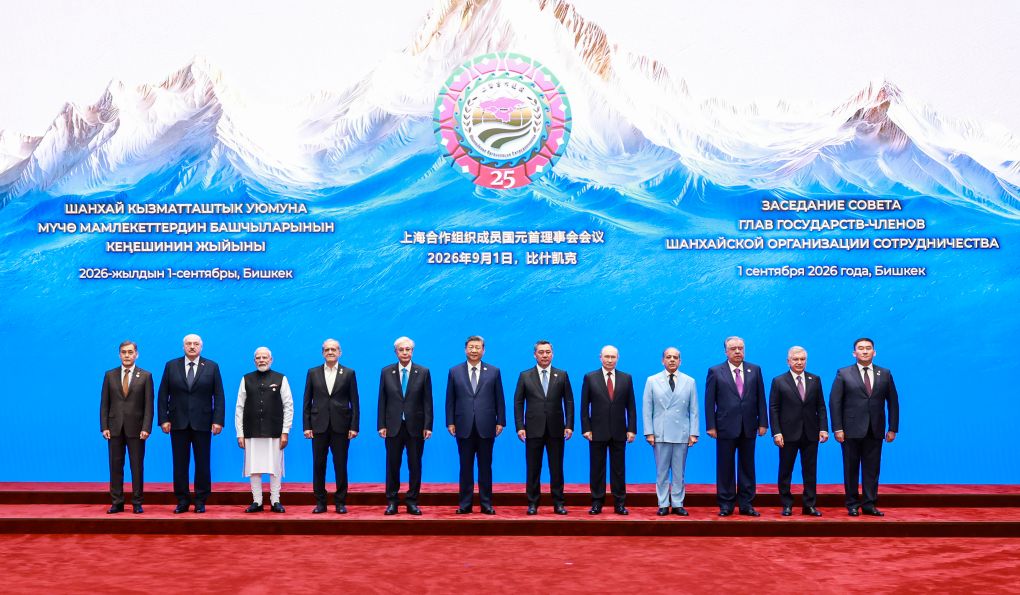
The 25th anniversary celebration of the founding of the Shanghai Cooperation Organization (SCO) in Bishkek, Kyrgyzstan is setting the tone for a new direction in international relations. Beyond the ten member states and their highest level of leadership including China, Russia, India, Iran, Pakistan, Kazakhstan, Kyrgyzstan, Tajikistan, Uzbekistan, and Belarus, there are also leaders and politicians from Egypt, Turkey, Mongolia, Turkmenistan, Azerbaijan, Armenia, Vietnam, Laos and Togo participating. This represents between three to four billion people in the world’s population.
Although the SCO was founded in 2001 as a regional security mechanism, it is now emerging from its original core of Eurasia nations to embrace partners that reach far beyond this original group. The reason is not mysterious. The transformative nature of world policy away from the old post-World War Ⅱ dominant Anglo-American power structure towards a new constellation of developing nations, the Global South, has become a near new unstoppable geometry. Will Western Europe, the EU and the United States find the wisdom and foresight to change course and join the great majority of the world’s people remains an answered question. The framework to find the global solutions for peace and development remains within the foundations of the Belt and Road Initiative. The central theme of infrastructure development and connectivity is still at the heart of the BRI.
It is therefore no surprise that especially the Central Asian nations and members of the SCO, Kyrgyzstan, Tajikistan, Uzbekistan, and Kazakhstan, understand so clearly that connectivity is essential for the Central Asian countries that have no direct access to the seas. This is more than railroads, trade and roads. It means integrating energy systems, financial systems, through the Asian Infrastructure Investment Bank (AIIB) for example, and political friendships. This also means Autonomy and Independence for these nations. It defines a new direction for world policy, an end to Halford Mackinder’s geopolitical arrogance on behalf of the British Empire and its allies, that “He who controls the Asian Heartland controls the world.” Even his ally, Rudyard Kipling’s old but clearly outdated maxim “East is East and West is West and never the twain shall meet” has both come to a well-deserved end of the line in world history.
The fact that this conference precedes the September 1st to 4th Vladivostok summit of the Eastern Economic Forum and the BRICS conference in New Delhi, India on the 12th to 13th of September is an additional sign of the New World Order’s inevitable emergence. Creative reason, the unique quality of the human being, that which distinguishes us from the beasts, is what needs to guide human affairs if humanity has a future worth celebrating.
The SCO conference demonstrates the proper nature of dialogue and respect for all civilizations and it has set the stage for a far different approach of communication and diplomacy between nations than the alternatives of imposing sanctions and the use of military force to enforce subjugation and humiliation. The unrestricted use of force and power to decide differences between people is a dead end. The immediate threat of escalating conflicts resorting to the use of nuclear weapons is indicative of the overhanging instability and turbulence that threaten humanity’s future.

There are, however, even more profound challenges that await humanity. Diplomacy is most certainly, a good beginning but it by no means resolves the more profound questions awaiting solutions for humanity. The principles within the Peace of Westphalia and the UN Charter can well provide the road map for peace, and sovereignty and are clearly a critical step forward. But the ability for human beings to discover and/or rediscover the spirit of creative reason raises the ultimate challenge. Since we are not fundamentally creatures limited by brute force, we have a divine spark that unites humanity with the laws of the universe. This harmonic interaction between the human being in both heart and mind, and the physical universe is a type of force-free relationship. When people ignore or fail to understand this divine quality in themselves and their fellow human beings, they are rapidly reduced to the level of the beasts. They resolve problems and challenges by brute force, the so-called “Law of the Jungle.” The policymakers of the US and its international allies in the EU, NATO, and AUKUS, fail miserably in appreciating and understanding this reality. The results are that the Western World attempts to maintain power and influence by arrogance and dominance against a rapidly emerging majority of developing nations.
There is a great historical essay from the end of the 16th century written by the Italian Jesuit in China Matteo Ricci (Li Madou) entitled “You Lun” (Essay on Friends). This was later changed by one of Ricci’s Chinese friends to “Jiaoyou Lun” (Treatise on Friendship) and referred today as “On Friendship.” This little-known essay in today’s world especially, outside of China has underlying significance for today’s challenges. It elevates a thought process that could well aid the present Western policymakers to rethink their present ways of behaving. The three thematic areas of friendship consisted of cultivating virtue, sharing wealth, and seeking new friends from afar. A useful quote on ideal friendship from European Renaissance thought comes from Reginald Hyatte:
“Perfect friendship exists only between virtuous men (and women) who love virtue in one another for its own sake; amici veri (true friends) are like a single soul in two. While growing closer to one another in intimacy, they also grow in virtue and wisdom that benefits others beside themselves… True friendship has its primary object not another person but perfect wisdom, goodness, and beauty, which are essentially friendly, benevolent and beneficent. True friends love these qualities which they see reflected in their partners.”
This concept of friendship is found throughout Ricci’s essay. It was the first ever such essay in Chinese language written by a European in1595; yet even more remarkable, there are only two Europeans commonly well-known in Chinese history, one being Marco Polo and the other Matteo Ricci (Li Madou). Despite this, the English translation On Friendship, has only first become available in 2009, more than 400 years after it first appeared. This points far beyond the historic initiative to bring European and Chinese civilizations together in friendship at that time. It sets the bar very high for humanity today, but it can lead the world forward from the SCO conference beyond even diplomacy and dialogue to a universal principle of friendship that unites all nations and people.