

This interview was published in Chinese language in the magazine of the Chinese Academy of Social Sciences (Chinese Social Sciences Today) on October 14, 2026. This translation is made and edited by the Belt and Road Institute in Sweden (BRIX).
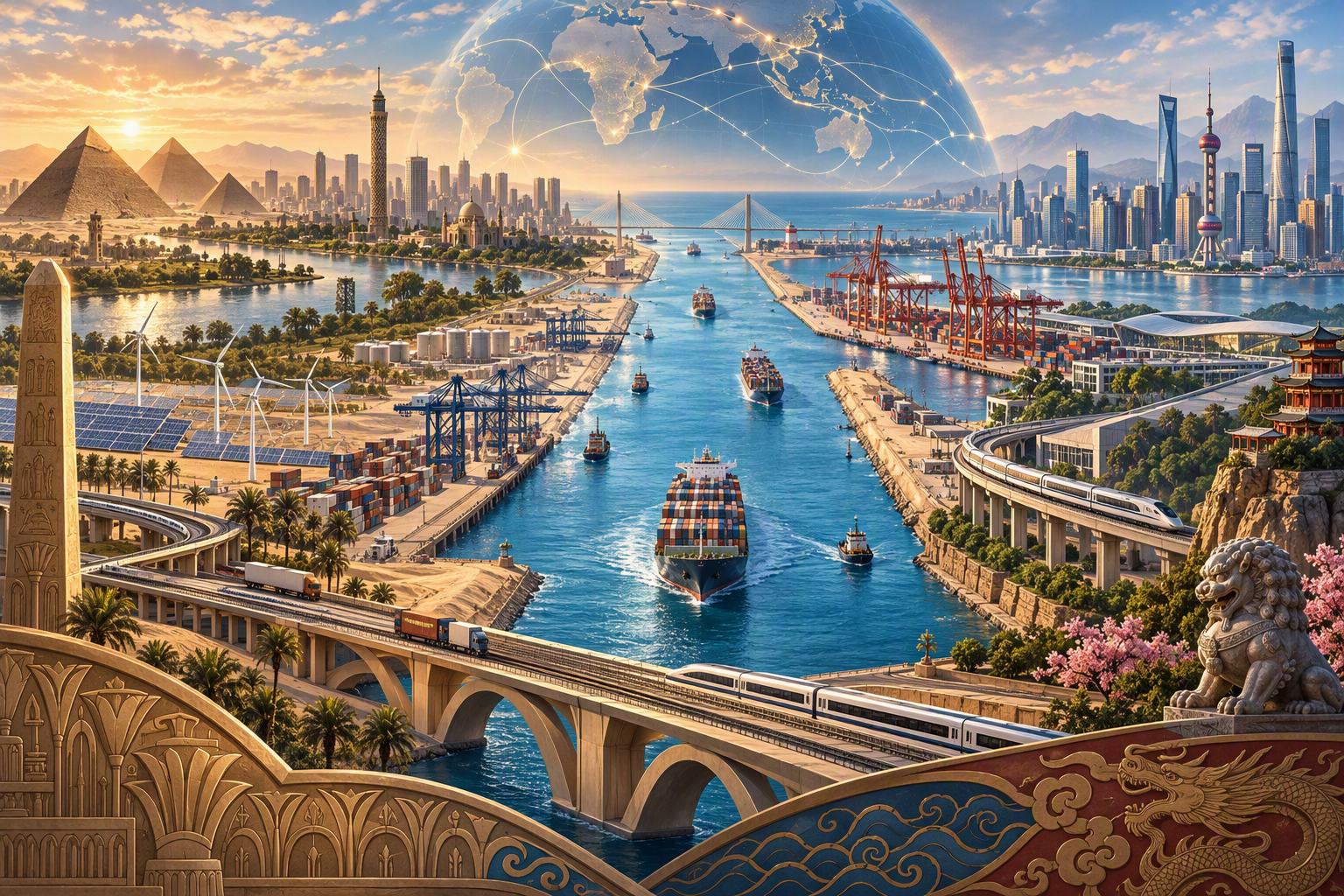
At the junction of the Red Sea and the desert, a canal carries the pulse of global trade and reflects an ancient civilization’s desire for revival. Egypt, the land nurtured by the Nile River, is making steady progress towards the comprehensive sustainable development and balanced regional development described in “Vision 2030”. From the historic handshake at the Bandung Conference to coordination and cooperation on multilateral platforms such as the United Nations and BRICS, China and Egypt have always been the backbone of unity and cooperation in the global South. The spirit of South-South cooperation has been continuously refined and continued in every leap in the relationship between the two countries. In 2026, the two countries will celebrate the 70th anniversary of the establishment of diplomatic relations. President Xi Jinping once again set foot on the land beside the Nile River after ten years. More than 30 cooperation documents have pushed bilateral relations to a new height of “a community with a shared future.” Focusing on topics such as China-Egypt industrial cooperation reshaping the pattern of regional connectivity, financial collaboration expanding the autonomous space for finance in the global South, and dialogue among civilizations and knowledge sharing giving rise to new forms of civilization, our reporter Liu Yuwei interviewed Hussein Askary, international relations scholar, co-founder and Vice-Chairman of the Belt and Road Institute in Sweden.
A Model of Mutually Beneficial Cooperation in the Global South
Chinese Social Sciences Today: The year 2026 marks the 70th anniversary of the establishment of diplomatic relations between China and Egypt. In your view, what is the core driving force that has enabled China-Egypt relations to remain resilient through 70 years of shifting circumstances?
Askary: The relationship between China and Egypt—and its evolution—serves as a vivid illustration of the Bandung Spirit. Following the Egyptian Revolution of July 1952, Gamal Abdel Nasser attended the 1955 Bandung Conference in his capacity as President of Egypt. During the conference, he met with Chinese Premier and Foreign Minister Zhou Enlai, a meeting that fostered the development of ties between the two nations. On May 30, 1956, China and Egypt issued a joint communiqué on the establishment of diplomatic relations, making Egypt the first Arab and African country to establish formal diplomatic ties with the People’s Republic of China.
Over the decades, the spirit of solidarity and cooperation within the Global South has been forged and sustained—even amidst turbulence and economic hardship—remaining a vital force in steering the international order toward greater fairness and equity. China deeply values the support it received from Egypt and other African nations in 1971, which helped restore China’s [People’s Republic of China -ed] lawful seat at the United Nations. Conversely, African nations also value China’s steadfast support for their struggles for national independence, the safeguarding of national sovereignty, and the advancement of their development endeavours.
Since the establishment of a comprehensive strategic partnership between China and Egypt in 2014, their political mutual trust has continuously deepened. In 2024, the two sides reaffirmed in a joint statement their commitment to advancing toward the goal of building a China-Egypt community with a shared future for a new era. This September, the heads of state of the two countries held talks in Cairo, during which they exchanged in-depth views on China-Egypt bilateral relations and cooperation across various fields. The outcomes of these talks have not only injected new momentum into the comprehensive strategic partnership between the two nations but also contributed to the development of a China-Arab community with a shared future and the construction of a high-level China-Africa community with a shared future. This relationship—characterized by mutual appreciation and support—serves to further solidify the foundation for the development of China-Egypt bilateral ties.
Chinese Social Sciences Today: China and Egypt maintain coordination within multilateral financial mechanisms—such as the BRICS, the Asian Infrastructure Investment Bank (AIIB), and the New Development Bank (NDB)—and jointly advocate for a more equitable and just global governance system. Can financial cooperation between the two countries help foster a more meaningful “Global South consensus”?
Askary: Although Egypt is situated in one of the world’s most volatile regions, it plays a significant role as a stabilizing and balancing force. On one hand, Egypt participates in multilateral platforms like the BRICS and the Shanghai Cooperation Organization (SCO) without distancing itself from its existing partners—a testament to its high degree of strategic prudence. Its relationships with China, the BRICS, and the SCO provide Egypt with financing channels and market access options that exist outside of Western-dominated avenues. Furthermore, Egypt’s cooperation with China under the framework of the Belt and Road Initiative is bringing advanced technologies and industrial capabilities to the country.
On the other hand, a protracted financial crisis has led Egypt to place greater emphasis on the BRICS New Development Bank, the Asian Infrastructure Investment Bank, and bilateral opportunities involving Chinese banks and financial markets. These channels are providing Egypt with new sources of finance and credit. Egypt was among the first countries in Africa—and within the Global South—to utilize Chinese “Panda bonds” for financing. Compared to bonds denominated in U.S. dollars or euros, Panda bonds offer lower interest rates and are free from the “policy-reform” conditions often attached to Western-issued debt. Meanwhile, the local-currency swap arrangement between China and Egypt has been renewed and expanded, helping to reduce reliance on the U.S. dollar for trade and investment while bolstering financial resilience. Both sides have also encouraged financial institutions to direct more resources toward industry, development investment, infrastructure, and projects focused on green and digital transformation. This suite of arrangements offers Egypt new alternatives outside the U.S. dollar-based system, contributing to greater financial autonomy for the Global South and enabling nations within it to access international capital markets based on their own creditworthiness. This is of critical importance to Egypt’s modernization process, particularly in the realm of infrastructure.
Industrial Cooperation Reshapes the Landscape of China-Egypt Economic and Trade Relations
Chinese Social Sciences Today: China has remained Egypt’s largest trading partner for 14 consecutive years. While bilateral trade volume continues to grow, a structural imbalance persists. How do you assess the transformation of China-Egypt economic and trade cooperation? Where do the most promising areas for growth lie in the near term?
Askary: Between the 1990s and the early 2000s, Egypt faced a severe economic crisis, rooted in the implementation of failed neoliberal policies. These policies undermined the country’s agricultural and industrial potential, leaving Egypt increasingly dependent on external aid. Since 2013, Egypt has pursued a path of autonomous development, aiming to build a self-reliant, open, and advanced nation. However, the capital, technology, and industrial foundation required to achieve these goals remained relatively weak.
Egypt’s “Vision 2030” and the “Belt and Road Initiative” are highly complementary in strategic terms. Aligning projects under these two frameworks is a crucial step toward unlocking Egypt’s immense potential. The structural trade imbalance with China is not unique to Egypt; addressing it requires a comprehensive boost to the productivity of the Egyptian economy, starting with the development of modern infrastructure. The opening of the New Suez Canal in 2015 and the establishment of the Suez Canal Economic Zone were significant milestones. Projects such as the China-Egypt TEDA Suez Economic and Trade Cooperation Zone and the Central Business District (CBD) in Egypt’s New Administrative Capital are driving industrial development and job creation. The Iconic Tower, the centrepiece of the CBD, stands at 385.8 meters—a testament to the joint efforts of Chinese and Egyptian builders—and now ranks as the tallest building in Africa.
In the near term, sectors such as renewable energy, electric vehicles, and the digital economy are poised to become new growth drivers for China-Egypt economic and trade cooperation.
Chinese Social Sciences Today: Egypt is a pivotal nation within the Arab, African, and Islamic worlds. Spanning both Asia and Africa, it plays a significant role within the frameworks of the China-Arab States Cooperation Forum and the Forum on China-Africa Cooperation. In the context of China-Egypt cooperation under the “Belt and Road Initiative,” how does the Suez Canal Economic Zone (SCZone) serve as a bridge—deepening its reach and influence across markets in Asia, Africa, and Europe, while also fostering alignment with the African Continental Free Trade Area (AfCFTA)?
Askary: As the most populous Arab nation—with a population projected to reach approximately 109 million by 2025, a large proportion of whom are youth and children—Egypt once viewed this demographic reality as a developmental hurdle, given the resources required to sustain, educate, and accommodate such a population. Today, however, as the modernization process advances, this demographic scale is transforming into a developmental asset. Egypt’s industrialization and the transfer of technology across various sectors are accelerating this transition, with China-Egypt cooperation serving as a key catalyst.
Chinese enterprises were among the first to expand their operations into the Suez Canal Economic Zone. The TEDA Industrial Park, for instance, hosts numerous large-scale Chinese firms; it has not only generated thousands of jobs but has also facilitated technology transfer through joint ventures. As production scales expand—bolstered by Egypt’s strategic location, which offers proximity to markets in Africa, West Asia, and Europe—an increasing number of companies from China and other nations are accelerating their entry into the Suez Canal Economic Zone and other Egyptian cities.
Another milestone in China-Egypt cooperation has emerged in the construction sector. Chinese firms have been involved from the ground up in developing the Central Business District of Egypt’s New Administrative Capital—a project that has garnered significant global attention. Furthermore, the New Alamein City downtown tower project, undertaken by the China State Construction Engineering Corporation (CSCEC), stands as a major high-rise complex integrating residential and commercial functions. Upon completion, it will become the tallest reinforced-concrete residential building in Africa. As these towers rise to define the skyline of New Alamein, they represent more than just a framework of steel and concrete; they embody the aspirations of an ancient civilization for a more prosperous and self-determined future for the next generation.
Chinese Social Sciences Today: China and Egypt are highly complementary in terms of development needs and resource endowments, and Egypt’s geostrategic location further amplifies the spillover effects of bilateral cooperation. Cooperation in emerging fields such as new energy, the digital economy, and aerospace technology is showing strong momentum. How do you view the prospects for these collaborations to transform from project-driven initiatives into eco-friendly partnerships? How can the two countries transform their complementary advantages into sustainable competitiveness? Can this cooperation foster new models of regional technology cooperation?
Askary: The Belt and Road Initiative is moving towards a new stage characterized by industrialization and modernization, with technology transfer and industrial collaboration becoming a reality. China and Egypt have signed contracts worth billions of dollars in multiple fields, particularly in high-tech areas such as clean energy, information technology, and artificial intelligence. Cooperation is no longer limited to traditional industries such as home appliances and textiles but is expanding to many more areas. These include electric vehicles, shipbuilding, solar energy, wind energy, seawater desalination, cloud computing, data centres, semiconductors, aerospace applications, remote sensing, key mineral supply chains, agriculture, and automobile manufacturing. The core of this new stage is the simultaneous advancement of industrial localization cooperation and human resource capacity building. This has driven Egypt’s digital transformation and sustainable development, and has also gradually positioned Egypt as a regional hub connecting Asia, Africa, and Europe, encompassing sectors such as industry, logistics, clean energy, and the digital economy.
China’s high-quality development is now having a global impact, unleashing new productive forces. The unique aspect of China’s partnership with the Global South lies in its avoidance of technological monopolies, instead sharing the benefits of technological progress to achieve win-win outcomes for all parties.
As of 2023, Africa’s total population has surpassed 1.48 billion and is projected to reach approximately 2.5 billion by 2050, making it one of the regions with the greatest growth potential. The Belt and Road Initiative continues to spearhead this transformation, with Egypt positioning itself as a bridge connecting the development of China and Africa. The Julius Nyerere Hydropower Station in Tanzania, which became operational this year, serves as a recent example of large-scale infrastructure development in Africa. The project was developed by the Tanzanian government and constructed by a consortium of Egyptian firms, with Chinese companies supplying the turbine-generator units and auxiliary equipment, while also participating in construction and design. As one of the largest hydropower projects in Africa in recent years, it has enabled Egyptian companies to gain cross-border experience in major infrastructure construction and has facilitated skills training for the local workforce. This form of South-South cooperation is injecting new momentum into global economic growth and has emerged as a significant breakthrough in the evolving landscape of the global economy.
Promote new forms of civilization through knowledge sharing
China Social Sciences Today: The two ancient civilizations of China and Egypt are taking on new vitality through increasingly active people-to-people and cultural exchanges, and the two peoples are getting closer. How do you evaluate the significance of exchanges and mutual learning between civilizations in transcending the “clash of civilizations” theory and consolidating the foundation of China-Egypt civilization?
Askary: During President Xi Jinping’s state visit to Egypt in September this year, civilizational factors received equal attention as economic and strategic factors. The cultural exchanges between the two ancient civilizations transcend geographical distance and institutional differences. Both sides understand the profound heritage of the two major civilizations with an attitude of respect and appreciation, setting an example for the practice of global civilization initiatives. While respecting the diversity of civilizations, both parties pursue common values and goals and promote unity and harmony. This breaks the shackles of the “clash of civilizations” theory. Diversity and differences in civilizations are a source of wealth, not tension.
Mutual learning and contributions among civilizations are not a sign of superiority or inferiority. In Plato’s Timaeus dialogue, Critias narrates the story of an Egyptian priest informing the Athenian legislator Solon about ancient history and Egyptian wisdom. According to ancient records, Greek philosophers such as Pythagoras and Eudoxus travelled to Egypt and had close contact with Egyptian intellectual traditions. In the mid-eighth century, papermaking was introduced to the Islamic world via Central Asia, promoting the widespread diffusion of science, technology, philosophy and art in Eurasia and Africa. These examples illustrate that knowledge that has a positive impact on human development is never the private property of a certain civilization, but flows, transforms and is recreated between different centres.
Looking at the contemporary era, the cooperation between China and Egypt in the fields of archaeology, cultural heritage, and museums can be viewed within this same long-term historical continuum. The joint archaeological project at the Temple of Montu in Luxor, launched in 2018, brought together a team from the Institute of Archaeology at the Chinese Academy of Social Sciences and the Egyptian Ministry of Tourism and Antiquities. Recent discoveries include reliefs of the god Hapi and of priestesses, fragments of inscriptions, and a sacred lake previously undocumented in archaeological records. In 2024, the Shanghai Museum and the Supreme Council of Antiquities of Egypt co-organized the exhibition “On Top of the Pyramids: Ancient Egyptian Civilization.” Attracting over 2.8 million visitors—a global record for a single ticketed museum exhibition—the event also featured more than 6,000 offline educational activities. By presenting Chinese and Egyptian artifacts side by side, the dialogue between these civilizations extended from the archaeological field to the museum gallery.
Exchanges between civilizations are never one-way. They do not serve to rank one civilization above another; rather, they demonstrate how knowledge, technology, and institutions flow, transform, and are recreated across different centres. The dialogue and cultural exchanges between China and Egypt prove that “a single flower does not make a spring.” World culture is akin to a grand orchestra composed of diverse instruments, all playing together to create a harmonious melody.
Related items:
A Blueprint for Peace through Development in West Asia and Africa: New Report!