

VIDEO TRANSCRIPT
Gustaf Lansner: Hello and welcome to another podcast by the Belt and Road Institute in Sweden. My name is Gustav Lansner and I’m joined here today by our vice chairman Hussein Asghari. Welcome Hussein.
Thank you very much Gustav, it’s always a pleasure. Pleasure to have you here. Our theme today is the upcoming trade negotiations between Europe and China.
Last year there was a trade war you could say between the US and China with tariffs and all of that and now it’s the Europe’s turn and there will be negotiations from, as I understand it, from the middle of October and going forward a few months but we are already starting to feel the tension of this.
Hussein Askary: Yes, there has been some statements by for example German chancellor and French president that they might use some regulations like the United States used the so-called article 301 on forced labor that countries that use forced labor will have to face a tariff of 10% or 20% on their goods being exported to the EU. The Chinese already said if that happens we will retaliate and with even harsher response than what they did with the United States last year. If you remember the United States had to back down, President Trump had to back down and reached a settlement with China because the Chinese threatened that they will stop all exports of rare earth minerals and magnets to the United States and most of the American advanced industry including literary industry depends on that.
We have a similar problem in Europe so that’s where I think we there’s need to get a common understanding of our common interests rather than the confrontation.
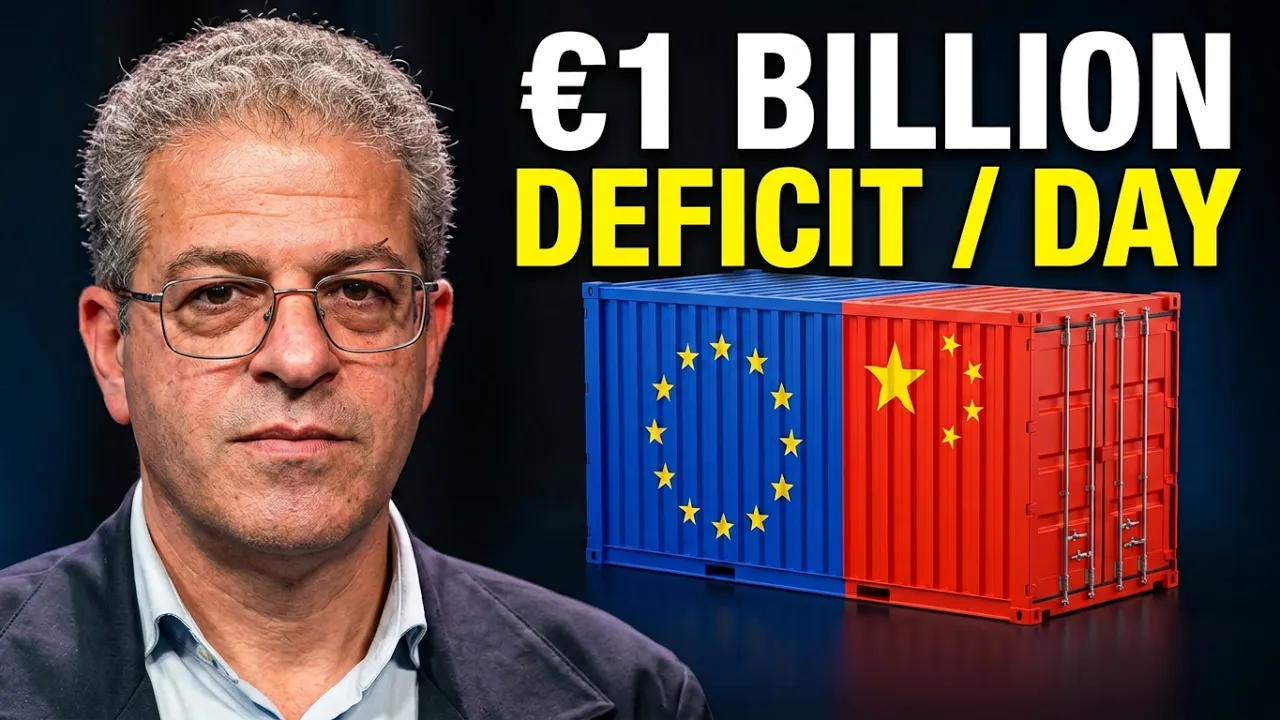
Gustaf: Right, so the trade deficit as I understand it amounts to about 1 billion euros per day and this is also happening in the middle of the oil crisis and everything so it’s a real situation but you were recently at a conference where this was discussed and you have the European side with their interpretation of things and the Chinese side. Can you tell us a bit?
Hussein: It’s called High Level Symposium on China-EU Cooperation and Relations. It was not meant to be an arena for disputes. It was originally thought as like previous years.
This was the first time I attend and speak there. It was organized by the Chinese Academy of Social Sciences which is a very important institution for social economic and political discussion in China and studies and there were representatives from the EU countries. For example there were some speakers representing the official EU, some represented their governments in the EU and there were of course on the Chinese side also government-related speakers and then there were people like myself and professors from universities that are independent people from Europe and China who were the so-called bridge builders.
We are not involved in any disputes but the first speech is immediately the European side started by pushing the normal narrative that the EU has an enormous trade deficit against China. EU Commission Chairman Ursula von der Leyen mentioned this 1 billion euros per day in deficit towards China and the whole thing is like as if this is something which just happened today or this year and it is all China’s fault. So there are lots of criticism of China by those speakers who represent the EU or their governments in the EU and then the Chinese responded by defending the Chinese position but also criticizing the European side.
So it started with a bit tension. The whole idea was that how do we get closer understanding of each other and cooperate but that was not what happened in the beginning but then in the afternoon myself and others were talking about ways to bridge the gap between the EU and China and find common ground for cooperation. So one of the main, there are several criticisms of China by the EU side which are worth mentioning is first of all that the Chinese government favors Chinese industries.
They provide them with enormous incentives, subsidies and credit, very cheap credit through their financial banking system so they can produce more and get ahead of the Europeans while they put restrictions on European companies working in China and restrictions on European products in China. Now the Chinese side says well this is not true. European companies are interested in manufacturing.
They are all welcome to set shop in China and take advantage of the Chinese market, the Chinese supply chains and the credit market. That’s all clear if you do manufacturing but if you are there to try to find ways of making money out of money like in the financial markets or speculation that’s not allowed in China because as you know the Chinese market is enormous savings in China, enormous credit market and many people in the United States, Britain and the EU in the financial sector they are eyeing this as this is a huge pool to dip into and get advantage of and the Chinese say no. If you want to work on the real economy on manufacturing technology you are welcome but you’re not welcome to come here and rig the market for financial gain. So this is one issue.
There is the other issue is that China is over produces, there’s over capacity in the industrial sector, produce too many cars, too many machinery, too many this and that and this is affecting the European market. The Chinese say well there is no such a thing as over capacity because when Germany was exporting cars to the whole world they didn’t need all these cars in Germany so they were exporting these cars to other parts of the world but that was not called over capacity, that was called excellence. Everybody wants to buy German cars and now when we export electric vehicles and other products which everybody wants in the world we are called over capacity producers.
So the Chinese are criticized for manipulating the currency, keeping it low to give an advantage to Chinese exports outside because they will look cheaper outside in the world but also foreign products will look more expensive inside China so China is manipulating the currency keeping it low. Well Sweden has been doing this for decades. We are an export dependent country and the central bank of Sweden always tries to keep the Swedish currency below par with other currencies so it can support our export industries.
The United States changes the interest rate every month or every three months and manipulate the dollar value all over the planet but that’s not called manipulation, it’s called just market rules. So the Chinese always have a way of replying to this and that was a bit problematic because we lost a lot of time and energy debating back and forth while losing sight of the real issues which for example I presented, we have discussed this in our podcast before, what is the problem with European and American industrial systems because we have had decades of decline not because of China but because of our own policies of financialization, de-industrialization and now militarization that we lost sight of the development of our people, of our infrastructure, healthcare, education and increasing our productivity. We also have this fanatical so-called climate reset, the green transition which we are too extreme in that and this way we are shooting our feet, shooting our own feet in this process by actually making it impossible to have certain industries in the EU or in the United States and this is to a great advantage for other nations in the developing sector.
One other criticism of China is that the Europeans say China is no longer a developing country, it should not have the privileges of a developing country like giving subsidies to its industries and having all these things and open market access. But isn’t there some truth in that at least? Well it’s not so black and white because if you go to the most advanced cities in China, you go to Shanghai, Shenzhen, Guangzhou, even Beijing, it’s enormously developed.
It’s more developed than maybe most European cities but that’s not the whole reality of China. China, if you go to the rural areas, if you go to the inland provinces like Guizhou, Xinjiang, these are still in the developing process. They are not very poor but they are still poor in a sense.
There are 500 million Chinese middle class but that leaves about 700 million who are still not in the middle class. China has a long-term policy to 2035 to raise everybody to this middle income level but of 2049. So China says we are still a developing country.
Yes, we have these advanced industries and infrastructure but we still have a long way to go. So in that sense, also China considers itself a member of the global south nations which also will create certain problems for the EU. So these debates between the EU and China right now, they are not constructive, they are not going to help us get over this situation.
Gustaf: Right, okay. So do you see a way out of this? What would you like to contribute to this discussion?
Hussein: Well, what I presented in the conference was that, okay, first of all, we have to look inward, look ourselves in the mirror in the EU and find out why are we not competitive anymore, why we have all these problems. Before we look at China, we should stop this obsession with China as one of our friends said in Germany, Dr. Michael Bree, which I interviewed recently in one of our podcasts, he said, stop the obsession with China, let’s look at our own turf, where things went wrong, why have we stopped developing. And one of the things I presented at the conference is that there is a study by the German Transport and Digital Infrastructure Ministry which said recently that there are about four to five thousand bridges in the German highways that are in urgent need of replacement.
These are dangerous. This is the German government saying so. So I said, instead of looking, everyone was talking about the death of the German auto industry, which is in a way true.
This is one other point that why the Chinese are not buying European products, because the Chinese can produce these products. They don’t need to buy German cars anymore in the same extent they did before. They are buying very good electric Chinese vehicles.
Gustaf: And cheap.
Hussein: So I said instead of focusing on the auto industry, let’s look at the autobahn industry, the German highways, the German railways. And this goes of course for every European EU country, because our infrastructure is outdated. We lost many industries who built the infrastructure.
Here in Sweden, we lost the nuclear industry, nuclear power industry. We built our own nuclear power plants in the 60s and 70s. The generation who built it have disappeared.
We have not created a new generation of builders of nuclear power. We need to focus on these things. We need to build new industries, for example, which we have been advocating for many years is that we should build a new generation of transport, like magnetically levitated trains, that we should have a Swedish industry.
The Germans abandoned the industry. China is developing that. We need to develop that industry.
So there are many things we have to look inward. We saw, which everybody was talking about during this conference, the PISA test. This is the test for 15-year-olds, their school performance, every country in the world almost, they participate in this.
And there was a big shock for all Europeans. Even here in the news, in the election debate, this was discussed because European youth are now way, way, way behind the Chinese, who are on the top. Singapore, East Asia generally, they are on the top.
And way behind them are Germany, France, Sweden, Denmark, Holland, behind the 20s. Even Turkey is ahead of most EU countries. So this is a big shock.
But this has nothing to do with China. It’s our own fault that our education systems, our infrastructure are not functioning, our healthcare system. So we have to look at this.
Then the other thing I mentioned is that I showed a graph, a graphic of the population projection, of the population growth in the next 50 to 100 years. And you can see clearly that in Africa, it’s the most growing continent. We have 1.3 billion Africans, mostly young, around 21 years of age on average. They will be about 2.5 to 3 billion by 2050. Europe will decline. Asia will decline, including China.
The United States and Latin America will stagnate. So the only place where you will have economic population growth is in Africa. Now, when you show this graphic to European politicians, what comes to their mind is all these Africans and the Mediterranean and rubber boats trying to come to Europe.
Because in their mind, Africa will forever be poor. There will be civil wars, coups, epidemics, so on and so forth. They don’t ask why are people leaving the continent or leaving the Middle East, including because of many wars the United States started that we support.
When the Chinese see the same graphic, what comes to their mind is that this is going to be the biggest market in the world and also the biggest workshop in the world. Because many industries can grow in Africa if you provide infrastructure, skills, credit, technology. And this is what is happening with the Belt and Road.
China is doing that already. Many African nations are taking the step into modernization and industrialization. And for China, this is a gold mine, not literally speaking.
It’s not about mining, because many African countries now say we are not going to sell you raw minerals. We want to have industries here to increase the value of these minerals. And China says no problem.
We can build battery factories. We can build industries here. It’s good for our companies.
Instead of exporting consumer goods to Africa, we can export technology and machinery to Africa. So this is where I said Europe, the EU should be involved with China. Everywhere China goes with the Belt and Road, we should be there to participate in that development process.
Make sure that there’s the financing, the technology and machinery to do these things. It’s good for Africa. It’s good for us, good for our corporations.
Because the idea if you make Africa rich, if you make Asia rich, you will benefit. This is the Chinese philosophy. We have a zero-sum game philosophy saying no, this is not going to happen because the Africans will eat up all the resources which we need.
So this is what I presented. Now there is another aspect of the immediate crisis with our auto industry, for example, and other industries which can be addressed even in the short term in these negotiations. Mm-hmm.
How? Well, I didn’t present this at the conference. This came up now after I looked at the recent discussion about the trade deficit, the negotiations, but also the news came yesterday that Volvo, the Swedish carmaker, the Volvo automobile, these are the small cars, not the trucks.
The Volvo automobiles are owned by Chinese companies for many years now, Geely, and they are doing very well, including with the electric vehicle sector. But when I looked at this, this image came to me that our industries, because we are a small country, and the EU is small relative to the whole world, but we are a small country relative to China. So we have many very productive, innovative industries, but they cannot compete with China.
They cannot compete so much in the world now as it advances. So this image I got, I was thinking about this fungi, the fungus in the forest. This is not a bad fungi.
These are the good guys.
Gustaf: Mushrooms.
Hussein: The mushrooms. And what they do is they create a massive network underground of threads and roots that help the trees, the big trees in the forest to get very elementary minerals from the ground and fluid and water. And then they get rewarded from the trees by getting the carbohydrates, the sugar, back.
Gustaf: Symbiotic relationship.
Hussein: So this is a symbiotic relationship between the fungi and the trees in the forest. It’s a fantastic ecosystem where everybody benefits. So this is my image that Swedish companies, especially innovative companies, they should live like fungi in the Chinese forest.
Not only in China, but also where China is active globally. There’s a global forest growing now in the global south. So our companies can actually be part of China’s rise.
So you are not free lifting, but you are working in symbiosis with the Chinese industrial development. And this way you can survive because China has enormous market, has enormous capacity, but it’s opening up the whole world market for us. And therefore our companies should be there.
When I looked, I mean, there are some Swedish companies now, including the truck companies, they’re also threatened. We have Scania and Volvo trucks. They are threatened by the Chinese electric trucks because the Chinese are way ahead of us in that sector.
And our government say, we have to move to electric trucks. And this means there will be no trucks except the Chinese ones. We are now trying to develop Volvo and Scania trucks.
They’re also to develop in this market, way behind Chinese market. But many of these companies, Swedish companies I know, are moving their research and development into China. Because in China you have not a pool, but a whole ocean of very skilled engineers, skilled labor, and a fantastic consolidated supply chain within China.
So anything you need, you can get within this ecosystem China has built. And this is fantastic for our companies who need to develop their products. But then you, like Volvo did, even if your sales decline in China, you can still compete with that in other parts of the world.
Like Volvo cars now, they’re hybrid cars, but also electric cars are some of the most popular in Europe. So their sales are going very well. It was going very well in the United States until Trump stopped the electric car.
They put enormous tariffs on Volvo and other electric cars in the United States. But this is the symbiosis I’m talking about. So we can benefit from China’s rise rather than be in a disadvantage.
And therefore our leaders in the EU in Sweden, we have to think in more open terms. First, solve our long-term deficit, our mismanagement of the economy, and then look at ways of cooperating with China to participate in the enormous development which will take place through the Belt and Road, with the BRICS countries, with the Shanghai Cooperation Organization, which opens a fantastic horizon for us.
Gustaf: Yeah. I mean, it sounds like there are, the way you put it, it sounds like there could be a very bright future, potentially.
Hussein: Yeah, definitely. But we need to change our way of looking at things. As I said, there’s this philosophical problem.
We have a zero-sum mindset, but also we like to lecture others. Something which I saw in this conference in Beijing, there are some European experts there just simply trying to lecture the Chinese. And it was, for the Chinese, it was very, very impolite.
First, you are in their country. Two, many of the things they were saying were just like cliches they have heard from European politicians or from media people. So we have to be more humble here in Europe by looking at these problems.
And mostly we have to look in the mirror and figure out what is wrong with us rather than what is wrong with the Chinese. We have this whole situation now with Ukraine, the war. I know this is sensitive, but we have to look at ways of finding a peaceful resolution.
Many people in Europe have this dream, I mean, industrialists, that we can save the European industry by converting our auto industry, machinery industry, into military industry. That’s not only destructive because you’re not producing any goods, you are still dependent on China for that military industry, both the United States and the EU. Because of the minerals.
The minerals, the magnets and many other products. And you will not get out of that trap. So we need to find a completely new way of looking at the world, looking at ourselves and finding ways of working with the world and against the world.
Gustaf: All right. Well, I think that’s a great conclusion. Unless there was something more you wanted to…
Hussein: No, I think this is basically the main… I mean, we’re going to write some more reports about this. We will follow the development and try to make an input.
I know these are very big questions. A small think tank like us might not be so effective. But I think maybe people in Sweden and in Europe, they need to think in these terms and open their mind to new ideas, new suggestions.
And this is what we do in the Belt and Road Institute. We are not a major political party or have enormous resources, but I think we have an insight which could be helpful for Swedish policymakers, for businesses, for even the general public to understand the world. And therefore people have to follow what we do, what we say and try to communicate with us and ask questions.
I think this, through our videos, through our articles, we open the door for people to have an open discussion in this society.
Gustaf: Yes. Okay. Well, thank you for today.
And yeah, if you like this conversation and like what we do, please help to initiate this very important and, how do you say, time-critical discussion. It’s very high time that we start finding alternatives to this otherwise very negative future. I mean, the future looks bleak in many ways, I think, for most people.
So it’s high time that we try to address that and to initiate the type of dialogue that you’re pointing towards. So yeah, please like, subscribe and share and all of that stuff. Okay.
Thank you.