

By Hussein Askary, Vice-Chairman of the Belt and Road Institute in Sweden
This article is based on an academic essay submitted by the author to the Department of Economic History and International Relations in Stockholm University in 2024.
In the soil of Sweden, the Baltic countries and Russia, archaeologists have uncovered one of the most arresting clues to the Viking Age: tens of thousands of silver coins struck far away in the Islamic world. Many were minted under the Abbasid Caliphate and its eastern extensions in Persia and Central Asia between the 9th and 11th centuries. Their Arabic inscriptions name rulers, mints, and dates. Their presence in Scandinavia points to a world far larger than the raiding ships and coastal settlements that dominate popular images of the Vikings.
The traders who moved through that world were not only Scandinavians sailing west. The Rus-Vikings, active across the river corridors of Eastern Europe and today’s Russia (giving it its current name), connected the Baltic Sea with the Volga, the Caspian, the Black Sea and the commercial zones of the Islamic caliphates. They carried furs, wax, amber, swords and slaves southward. In return, they brought back silver dirhams, textiles, beads, glass and other goods that tied northern Europe to markets stretching toward Central Asia, India and China (Bolin, 1939; Noonan, 1992; Johansson, 1997).
This article asks whether that trade was more than a set of profitable routes. Was it part of an early, polycentric form of globalization between 800 and 1100 AD? The question matters because globalization is often treated as a modern story beginning with Europe’s oceanic expansion or the industrial age. Yet scholars such as A.G. Hopkins and Janet Abu-Lughod have argued that earlier world systems connected economies, cultures and institutions across Eurasia and Africa long before modern capitalism (Hopkins et al., 2002; Abu-Lughod, 1989). The Rus-Vikings, seen through coins, Arabic texts and archaeological finds, may belong inside that wider story.
Beyond the image of the raider
The Viking Age has long been framed by ships, warfare and expansion. But the Rus-Viking story points to another reality: commerce. Swedish groups established themselves around Lake Ladoga (in the vicinity of today’s St. Petersburg) before 800 AD, moved toward Novgorod and Kyiv, and used river routes that opened access to the Black Sea and the Caspian. These waterways were commercial arteries, linking northern forests with steppe markets, Khazar and Volga Bulgar intermediaries, Byzantine ports and Islamic cities.
What the coins reveal
The strongest evidence for this long-distance exchange lies in silver. By the late twentieth century, numismatic studies had recorded roughly 69,500 Islamic coins in Sweden, with especially dense concentrations on Gotland and in Roslagen (Johansson, 1997). Later finds and archaeometry research have only strengthened the case that the Baltic economy was deeply connected to Eurasian silver flows, even before the better-known boom of the later ninth and tenth centuries.
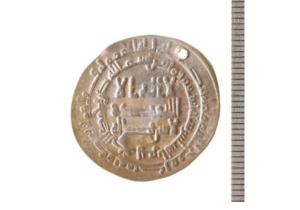
Silver dirham minted in 902 – 903, according to the description in the Historical Museum’s catalogue, by the Samanid dynasty of Ismail ibn Ahmad and al-Muktafi . The description is derived from the Arabic script on the coin.
A trade boom written in Arabic script
The inscriptions on dirhams are unusually useful historical witnesses. They identify minting authorities and places, allowing historians to trace shifts in power and trade. The silver arriving in Scandinavia in the tenth century increasingly came not from Baghdad itself but from the Samanid realm in Central Asia. This matters: it suggests that the economic gravity of the Islamic world had shifted eastward as Abbasid authority fragmented and new regional dynasties became commercial engines.
Marcus Johansson’s study of Islamic coins in Swedish, Baltic and Russian hoards showed that the Samanids were especially prominent in the finds. Thomas S. Noonan’s work likewise placed the trade in a broader economic setting: Rus and Viking merchants carried northern goods south and received dirhams in return, while Khazar and Volga Bulgar markets helped mediate the exchange (Noonan, 1992; Johansson, 1997). Recent research has reinforced that early Viking-Age silver in the Baltic often derived from Islamic sources, indicating that the region was more closely tied to Eurasian trade than older coin counts alone suggested.
The coins also speak to scale. Their arrival was not a random trickle of exotic objects. It was part of a system in which silver mines, mints, urban markets and merchant networks fed one another. Maya Shatzmiller has shown how early Islamic economic growth involved mining, monetization, urban expansion and institutions that lowered the costs and risks of long-distance trade (Shatzmiller, 2011). The dirham hoards of the north were therefore not isolated archaeological curiosities. They were northern fragments of a wider monetary world.
That wider world was not ruled from a single center. Baghdad mattered, but so did Samarkand, Bukhara, the Volga towns, Khazar centers, Byzantine ports and Baltic settlements. This is why the term “polycentric” is useful. It describes a system made of several cores and many connecting corridors rather than one empire commanding a passive periphery (Marks, 2004; Abu-Lughod, 1989).
Arab witnesses to northern traders
The written sources are uneven but invaluable. Northern Europe produced abundant archaeological material from the Viking Age but relatively few written records. The Islamic world, by contrast, produced chronicles, geographies, travel accounts and administrative works. For historians of Rus-Viking trade, Arabic texts became indispensable.
One of the most famous witnesses was Ahmad ibn Fadlan, who encountered Rus traders in 922 in Bolghar, the capital of the Volga Bulgars. His account describes the “Rusiya”, their appearance, customs and goods, and it has often been paired with archaeological evidence from Scandinavia. Ibn Fadlan noted that Rus women wore circular brooches and neck rings of precious metal, items that correspond closely to finds from Viking-Age graves and hoards (Lunde & Stone, 2012).
He describes two interesting items that the Viking women were wearing. He writes
“All their women wear on their bosoms a circular brooch made of iron, silver, copper, or gold, depending on their husband’s wealth and social position. Each brooch has a ring in which is a knife, also attached to the bosom.
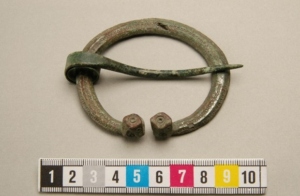
Ring buckle or brooch, dated 800-1100 AD. Credit: Amaya, Bertha, Swedish Museum of History/SHM (CC BY 4.0)
“Round their necks they wear torques of gold and silver, for every man, as soon as he accumulates 10,000 dirhams, has a torque made for his wife.” (Lunde & Stone, p. 46)
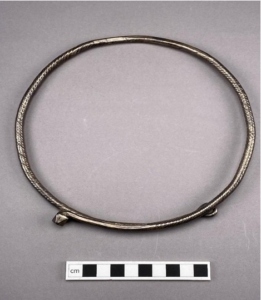
Permian neck ring. Dated to the 800-1000s. Credit: Kalmring, Sven, Swedish Museum of History/SHM (CC BY
The Baghdad question
Did Rus-Viking merchants actually reach Baghdad? The answer is less certain than some summaries imply. Ibn Khurdadhbeh, writing in the ninth century in his Kitāb al-Masālik wa-l-Mamālik, described “Rusiya” merchants carrying beaver and black fox pelts and swords from the lands of the Slavs toward Byzantine and Khazar-controlled routes. He wrote that after reaching the Caspian, they might carry goods by camel from Gorgan to Baghdad (De Goeje, 1889).
The word “might” is important. Unlike Ibn Fadlan, Ibn Khurdadhbeh was not reporting a personal encounter. Noonan warned that Islamic written sources often relied on second-hand information, copied earlier material and blurred distinctions among northern peoples (Noonan, 1992). Ibn al-Faqih, writing around 900, repeated a similar route but placed the destination at al-Rayy, near modern Tehran, rather than Baghdad. The evidence therefore supports Rus access to Islamic markets and trade circuits, but the precise endpoint of every journey remains open to scrutiny.
A market system, not a single road
The temptation is to imagine one grand route from Sweden to Baghdad. The evidence points instead to a network. Merchants moved goods through chains of exchange, tax points and market towns. The Volga and Dnieper routes connected northern producers with Khazars, Volga Bulgars, Byzantines and Muslim traders. Goods could change hands several times before reaching their final destination.
This network was multi-ethnic and multi-religious. Muslim geographers described Jewish Radhanite merchants who moved between the Mediterranean, the Indian Ocean, India and China, speaking Arabic, Persian, Greek, Frankish, Andalusian and Slavic languages (Abu-Lughod, 1989). Ibn Khurdadhbeh also described land routes that passed through Slavic, Bulgar and Khazar regions toward Central Asia and China (De Goeje, 1889). The Rus-Vikings operated in a commercial world already populated by translators, tax collectors, caravan routes and maritime connections.
The goods themselves reveal ecological and social differences across regions. The north supplied furs, wax, amber, and swords. Islamic and Central Asian markets supplied silver, beads, textiles, glass and possibly silk. A Chinese silk fragment from a Viking-Age burial at Birka, discussed by Annika Larsson, hints at how far some objects could travel before reaching Scandinavia (Larsson, 2020). A famous archaeological finding was made in 1954 in Ekerö municipality’s Helgö island, Stockholm, uncovering a bronze statuette of a sitting Buddha dated to the fifth century AD and originating from Swat Valley in northwest Pakistan. The statuette is believed to have reached Sweden in the eighth century AD.
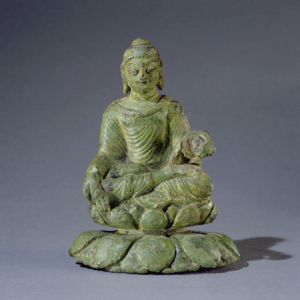
Buddha sitting on a lotus, bronze statuette, originating from northwest Pakistan and found in Sweden. Exhibited in Stockholm’s Museum of History. Photo by Gabriel Hildebrand, Historiska Museet (CC BY 4.0).
Such circulation does not mean that every person in the chain understood the full geography of the system. Globalization, even in modern times, often works through partial knowledge. A trader at Bolghar did not need to have seen China for Chinese silk or Central Asian silver to shape the price of goods in a northern market.
Was this globalization?
Modern definitions of globalization usually emphasize increasing interconnection across borders through goods, services, labor, technology, information and culture. By that measure, the world of 800–1100 was not global in the modern sense: the Americas were not integrated into this system, and the speed and volume of exchange were vastly different from those of the contemporary world. Yet many core ingredients were present across the “Old World.”
Hopkins and his collaborators called such earlier processes “archaic globalization,” forms of long-distance integration built by empires, merchants, religious networks, cities and migration (Hopkins et al., 2002). In this sense, the Islamic world after the seventh century became one of history’s most important engines of interregional connection. It linked the Mediterranean, North Africa, the Middle East, Central Asia, India, the Indian Ocean and parts of China. The Rus-Vikings entered this system from the north.
The Islamic concept of dar al-Islam provided a shared legal, monetary and cultural framework across vast territories, even as political power fragmented. Outside it, in what Muslim writers called dar al-harb, trade and diplomacy continued. Muslim, Jewish, Christian, Slavic, Turkic, Byzantine and Scandinavian actors all participated in overlapping zones of exchange. This was not a single peaceful marketplace, but it was a system with recognizable rules, institutions and expectations.
Shatzmiller emphasizes that institutions mattered: monetary standards, administrative offices, legal norms, credit instruments such as the suftāja, and market practices lowered transaction costs and made long-distance exchange easier (Shatzmiller, 2011). The dirham became more than a coin. In Scandinavia, where local silver supplies were limited, it functioned as bullion, wealth, payment and status marker.
One example is a silver dirham minted in 902–903 under the Samanid dynasty, attributed in the Swedish History Museum catalogue to Ismail ibn Ahmad and al-Muktafi. Its Arabic inscription gives the date and authority of minting, allowing the object to be placed in a precise historical and geographic context.
The coin is small, but the world behind it is large: silver mines in Central Asia, mint authorities, caravans, river routes, intermediaries, Scandinavian traders and eventual burial in northern soil.
Information, paper and cultural transfer
Trade was only one part of the story. Ideas, technologies and texts moved too. The spread of paper from China into the Islamic world after the eighth century transformed intellectual life. Jonathan M. Bloom has argued that paper helped produce an extraordinary expansion of writing in theology, science, literature, administration and commerce (Bloom, 2001). The importance of the transfer of paper production from China to the Muslim world and Europe and its revolutionary impact on civilizational development is dealt with in detail in a separate article by this author. Shatzmiller even estimates that paper production employed a measurable share of the labor force in Islamic economies (Shatzmiller, 2011).
This information revolution matters for Viking history because many of the written records that illuminate northern trade were produced in Arabic. Without geographers, administrators and travelers such as Ibn Khurdadhbeh and Ibn Fadlan, the archaeological silver would speak less clearly. Paper, bureaucracy and literary culture made the economic system visible to later historians.
Technology and culture also crossed borders in subtler ways. The Islamic world absorbed, adapted, developed, and transmitted knowledge from Greek, Persian, Indian and Chinese traditions. Works by Ibn Sina, al-Khwarizmi and Ibn al-Haytham later entered Latin Europe and shaped medicine, mathematics and optics. Musical instruments, religious ideas, artistic motifs and administrative practices also travelled along commercial and diplomatic routes (Marks, 2004; Bloom, 2001; Zou et al., 2022).
From Scandinavia’s perspective, this did not mean wholesale cultural transformation by the Islamic world. It meant contact: objects, coins, knowledge of distant markets, and traces of prestige goods that connected northern elites with a Eurasian economy. The evidence is fragmentary, but it is enough to unsettle any narrow image of the Viking Age as a purely European phenomenon.
The problem with a Eurocentric story
The debate over early globalization also challenges older European narratives. French historian Henri Pirenne famously argued that Islamic expansion turned the Mediterranean into a barrier and helped isolate western Europe. Sture Bolin disagreed, arguing that Islamic expansion could also stimulate trade, including the northern silver flows that reached Sweden (Bolin, 1939). The dirham evidence supports Bolin’s broader intuition: Islamic expansion did not simply close worlds. It opened new ones.
Abu-Lughod’s influential work placed a polycentric world system in the period 1250–1350, with several regional cores connected by trade rather than a single European center (Abu-Lughod, 1989). But for the Rus-Viking question, that date is late. By the thirteenth century, the northern silver flow that tied Scandinavia to the Islamic east had already faded. The evidence from 800–1100 suggests that an earlier version of polycentric integration was already operating. Thus, Abu Lughud’s account although meticulous, it is chronologically misplaced by more than two centuries. Besides, the Mongol Empire did not contribute to the expansion of this system but practically to its death.
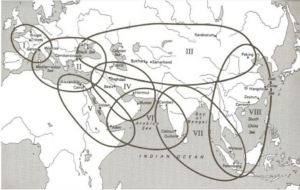
Janet Abu-Lughod’s map of the interconnected world system that existed between 1250 and 1350. Robert B. Marks calls it a ‘polycentric world system’ (Marks, 2004, p. 53). Map source: Janet Abu-Lughod, Before European Hegemony. The World System A.D. 1250-1350, Oxford University Press, Oxford, 1989, p. 34.
Robert B. Marks’s term “polycentric” captures what the evidence shows: regional systems with their own centers, connected through exchange (Marks, 2004). In the ninth and tenth centuries, the Rus-Vikings were not marginal barbarians outside history. They were northern specialists in a world of commercial interdependence.
A cautious conclusion
So, was Rus-Viking long-distance trade part of a polycentric globalization between 800 and 1100 AD? The answer is yes, if globalization is understood historically rather than anachronistically. It was not modern globalization. It did not create a single world economy or instant communication. But it did connect distant regions through money, commodities, institutions, written information, religious communities, technology and cultural exchange.
The Rus-Vikings participated in that system as carriers, intermediaries and consumers. Their routes linked Scandinavian settlements to the Volga and Caspian worlds; their goods supplied Islamic and Central Asian markets; their imported silver reshaped northern wealth and status. The hoards of Gotland and Roslagen are therefore not only Viking artifacts. They are evidence of an early Eurasian economy.
The most important lesson may be methodological. To understand this period, historians must read across regions and languages: Scandinavian archaeology, Arabic geography, Persian and Central Asian history, Byzantine diplomacy, Islamic economic institutions and Chinese connections. The views and research of scholars and experts from all these regions must be taken into consideration. A Europe-only lens makes the Viking Age smaller than it was.
In the end, the silver coins buried in northern fields tell a story of movement. They passed from mines to mints, from markets to rivers, from hands to hoards. They crossed languages, religions and political borders. Their journey suggests that between 800 and 1100, the Rus-Vikings were part of a connected, polycentric world—one whose history still lies partly hidden in the ground and partly preserved in the texts of those who watched strangers arrive from the far north.
References
Abu-Lughod, Janet, 1989, Before European Hegemony: The World System A.D. 1250-1350, Oxford, 1989.
Allen, Robert C., 2011, Global Economic History: A Very Short Introduction. Oxford University Press.
Bloom, Jonathan M., 2001, Paper before Print: The History and Impact of Paper in the Islamic World, Yale University Press.
Bolin, Sture, 1939, Mohammed, Charlemagne, and Rurik, Scandia: Journal of Historical Research, Volume XII. 1939.
De Goeje, M.J., 1889, Ibn Khurradādhbih’s Kitāb al-Masālik wa l-Mamālik, Edited, Brill, Leiden.
Hopkins, A.G., et al, 2002, Globalization in World History, Pimlico Random House.
Johansson, Marcus, 1997, Islamic Coins: A study of some late dynasty coins found in Swedish, Baltic and Russian hoards, Stockholm University Numismatic Research Group, 1997.
Kowalski, Tadeusz, 2022, Ibrahim ibn Yaqub’s Account of His Travel to Slavic Countries as Transmitted by Al-Bakri, Peter Lang GmbH Internationaler Verlag der Wissenschaften, Berlin.
Larsson, Annika, Asian Silk in Scandinavian Viking Age Graves, Östasiatiska Museet, Bulletin No. 81, 2020, pp. 107-147.
Lunde, Paul & Stone, Caroline, 2012: Ibn Fadlan and the Land of Darkness: Arab Travelers in the Far North, Penguin Books.
Marks, Robert B, 2004, The origins of the modern world, Swedish edition, Arkiv Förlag.
Martell, Luke, 2010, Sociology of Globalization, Polity Press.
Noonan, Thomas, 1992, Fluctuations in Islamic Trade with Eastern Europe during the Viking Age, Harvard Ukrainian Studies, December 1992, Vol. 16, No. 3/4, pp. 237-259.
Ping, Ye Zhi et al, 2024, Internationalization of Chinese Muslims Ummah during The Tang Dynasty, Journal of Strategic Studies & International Affairs 4, no., pp. 106-116, Keebangaan University, Malaysia.
Shatzmiller, Maya, 2011, Economic Performance and Economic Growth in the Early Islamic World, Journal of the Economic and Social History of the Orient, 54, pp 132-184, Western University, Canada.
Shatzmiller, Maya, 2009, Transcontinental Trade and Economic Growth in the Early Islamic Empire: The Red Sea Corridor in the 8th-10th Centuries, Western University, Canada. https://www.history.uwo.ca/People/Docs/Shatzmiller-Articles/12-Transcontinental-Trade.pdf
Zou, Ivan Yifan et al, 2022, The Boundary of Chinese Music: A Cultural and Aesthetic Comparison between Pipa and Guqin, The Journal of Chinese Literature and Culture, Duke University Press, pp 425-457.
Related items: