

Hussein Askary, Vice-Chairman of the Belt and Road Institute in Sweden
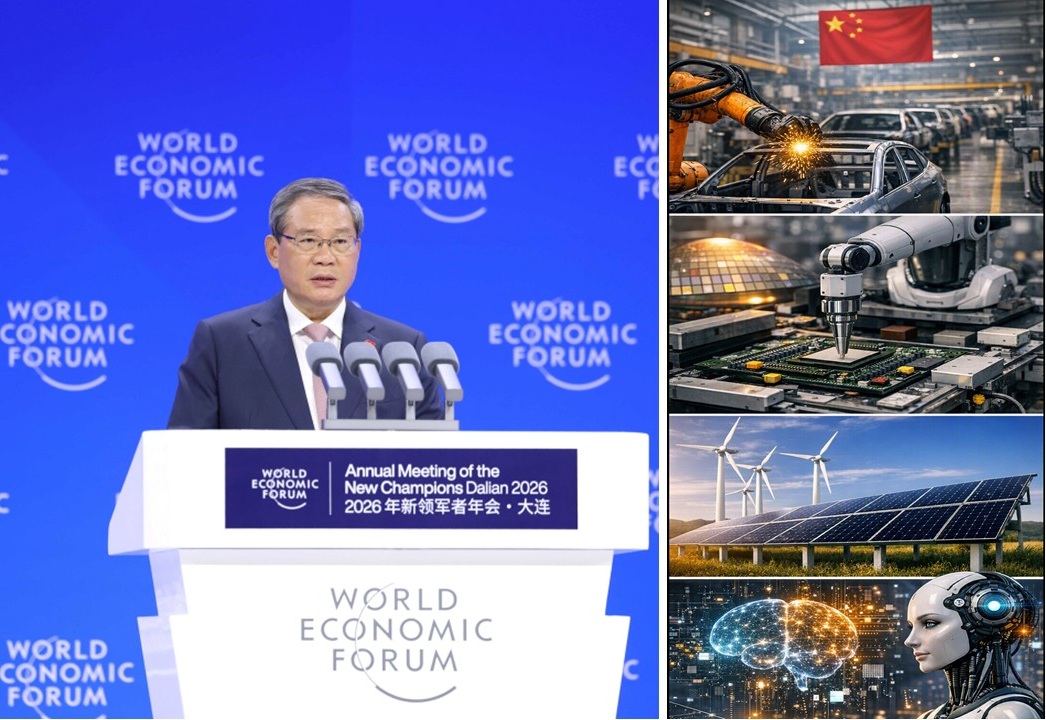
The World Economic Forum’s 17th Annual Meeting of the New Champions (also known as “Summer Davos”) took place from June 23–25, 2026, in Dalian, China. Under the theme “Innovating at Scale,” the event convened over 1,700 leaders from more than 90 countries to discuss how to translate technological breakthroughs into broad economic benefits and jobs.
The keynote speech by Premier Li Qiang presented China’s current economic trajectory as a case study in innovation-led development. Its central claim is that China’s economic resilience is no longer primarily rooted in low-cost manufacturing or export expansion, but in the emergence of a broad, technologically advanced innovation system. The speech frames innovation as one of the four defining features of the Chinese economy—alongside stability, dynamism, and integration—and argues that innovation has become the main source of renewed growth. Li states that “China has become a hub of rapidly emerging new technologies, new products, and new business models,” and then lists concrete fields where China is making visible progress: commercial rockets, quantum information, integrated circuits, nuclear fusion, artificial intelligence, embodied intelligence, smart devices, new energy vehicles, and intelligent connected industries.
A key achievement emphasized in the speech is the scale and speed of China’s technological progress. In artificial intelligence, Li describes “explosive growth,” noting that “several major AI models have reached new milestones in performance” and that daily token usage had reached “several hundred trillion” by the end of May, ranking first in the world. This is used not merely as a technical statistic, but as proof that China is becoming a global centre of applied frontier technology. The reference to “embodied intelligence” moving into “large-scale commercial application” is especially important because it suggests that innovation is not confined to laboratories, research papers, or prototypes. Instead, China is presented as a country capable of rapidly moving new technologies into production, industrial use, and mass-market deployment.
The speech also sought to explain how these achievements were produced. Li rejects the idea that China’s technological rise is based on imitation or artificial support, insisting that “there are no shortcuts in sci-tech research” and that “no one can copy their way to an innovation edge.” He pointed instead to sustained research investment, enterprise resilience, and long-term state planning. During the 14th Five-Year Plan period, China’s total R&D expenditure is said to have grown by “an average of 10 percent annually,” making China “the world’s second-largest R&D spender.” The speech also stressed that basic research reached a record level, accounting for “more than seven percent of total R&D expenditure.” These figures are presented to support the argument that China’s innovation capacity rests on accumulated effort and original technological capability, rather than on copying foreign technology or relying mainly on subsidies.
Another major theme presented by Li was the relationship between innovation and industrial application. He argued that China’s strength lies in crossing what Li calls the “Darwinian Sea” between the laboratory and the market. This phrase captures one of the speech’s most important arguments: many countries can produce scientific discoveries, but fewer can turn them quickly into commercially viable products and full industrial ecosystems. China’s “complete industrial system” and “big market” he portrayed as decisive advantages because they allow new technologies to be tested, refined, scaled, and commercialized rapidly. In this interpretation, China’s huge domestic market of more than 1.4 billion consumers becomes not just a source of demand, but an innovation accelerator.
Premier Li further highlighted China’s innovation ecosystem: infrastructure, talent, investment channels, industrial clusters, and institutional reform. Li noted that China trains “some seven million university graduates in science, engineering, agriculture and medicine every year,” and that 24 of the world’s top 100 innovation clusters are in China. These examples are used to show that innovation is systemic rather than isolated. The mention of the Yangtze River Delta’s “one-hour electronic information innovation circle,” Chongqing’s “one-hour motorcycle industrial circle,” and Shenzhen’s “30-minute supporting circle” in Robot Valley illustrates how geographic proximity, specialized suppliers, skilled labor, and rapid prototyping reinforce one another. China’s innovation achievement, in this account, is therefore not only technological but organizational: it has built dense industrial networks capable of turning ideas into products at speed.
Countering excitement about China’s rapid development
The most politically significant part of the speech is its direct response to the “China Shock 2.0” thesis. The expression “China shock 2.0” stems from the original “China shock” thesis coined by economists David Autor, David Dorn, and Gordon Hanson in their influential 2013 research The China Syndrome. The original authors—specifically Gordon Hanson and David Autor—first prominently applied the “China shock 2.0” label in op-eds and policy essays (such as in their July 2025 New York Times guest essay) to describe a new wave of intense global economic competition. While the first shock (1999–2007) was characterized by China undercutting the West on low-wage, low-skill manufacturing like textiles and basic goods, “China Shock 2.0” refers to China’s rapid post-pandemic industrial upgrading. It describes a dynamic where China dominates high-tech, high-value sectors such as electric vehicles (EVs), AI, telecommunications, and clean energy. The thesis suggests that China’s new wave of technological and industrial upgrading could disrupt global markets in the same way that earlier Chinese manufacturing exports disrupted some Western industries.
Li acknowledges that “some” are anxious about China’s “sci-tech and industrial innovation” and have therefore advanced the idea of a “so-called ‘China shock 2.0.’” His rebuttal is to replace the language of shock with the language of opportunity. He argues that there is now “more mentioning of an opposite term,” namely “China opportunity 2.0.” This rhetorical shift is central: China is not presented as a source of destabilizing overcapacity or unfair competition, but as a platform for shared growth, technological access, investment returns, and global modernization.
The speech’s refutation of “China Shock 2.0” rests on the distinction between “market dividends” and “innovation dividends.” Li argues that in the past, China’s large market and production capacity gave the world “market dividends,” while today China is also providing “innovation dividends” through technological progress and industrial upgrading. This is a crucial argumentative move. Instead of accepting the premise that China’s rise threatens others, Li stresses that China’s scale lowers innovation costs, improves supply-chain efficiency, opens commercial opportunities, and helps foreign firms become more competitive. The evidence offered includes the growth of foreign-funded scientific and technological service firms: in 2025, “14,000 foreign-funded enterprises were established in the fields of scientific research and technological services,” an increase of 27.2 percent year-on-year. This is used to suggest that foreign companies are not fleeing China’s innovation ecosystem but entering it more deeply.
Although Premier Li does not name specific Europea and international companies, publicly available information confirm his claim. Several well-known Swedish companies have established R&D projects in China, particularly in the medical, industrial, and automotive sectors. Many of these have evolved into global hubs serving worldwide markets. Elekta has its largest global software R&D centre in Shanghai and a full-scale production base in Beijing. The focus has shifted from “produced in China” to “developed in China,” with Chinese R&D outcomes now serving global markets. SKF established its Asia-Pacific headquarters and R&D centre in Jiading, Shanghai (with over RMB 200 million invested). It has relocated its global largest and only dedicated R&D centre for deep-groove ball bearings to China and also operates a global technology centre and testing hub there. Recently, it formed a joint venture with Leaderdrive to develop robotic joint components for humanoid robots. Scania invested EUR 2 billion in a production base in Rugao, Jiangsu, while maintaining R&D centres in Shanghai, Beijing, and Rugao, employing over 600 engineers to leverage China’s technological advantages in developing products like electric heavy-duty trucks. ASSA ABLOY relocated its global smart home software R&D centre from the US to Shanghai and operates a smart lock R&D centre in the Greater Bay Area, capitalizing on local AI and electronics industry strengths, with results serving global markets.
Additionally, according to a report by the Swedish research institute FOI, many other Swedish companies are involved in supply chain activities in China—particularly in “information and communications technology”—which implies ongoing technical collaboration and development.
Several major EU corporations have established significant R&D projects in China. Among these are France’s Dassault Systèmes, Germany’s Bayer, Volkswagen Group, Continental, Bosch, and many more from a majority of the EU member states.
A shared global good
The global-development argument is equally important. Li stated that China’s innovation makes advanced technologies “more accessible” and allows outcomes to be “widely shared.” He emphasized China’s “open approach to innovation,” pointing to open-source AI models, shared scientific facilities in controlled nuclear fusion and quantum technology, and the Tiangong space station’s planned reception of foreign astronauts. The sentence “what China’s technologies and products in emerging areas bring to the world are not shocks or threats, but opportunities and empowerment” functions as the clearest rebuttal of the China Shock narrative. It turns the accusation around: if Chinese technologies are affordable, open, scalable, and useful for developing countries, then the real global significance of China’s rise is not disruption but empowerment.
Against the “China Shock 2.0” thesis, the Li argued that China’s innovation does not simply export competitive pressure; it creates new markets, reduces costs, expands access to technology, strengthens global supply chains, and offers foreign firms and developing countries new possibilities for growth. The deeper message is that the world should view China’s technological rise not as a threat to be contained, but as an opportunity to be engaged.
Sweden and the EU stand to gain much from China’s breakthroughs in innovation if they position themselves strategically to become an integral part of the potential presented by what China has achieved and intending to reach in the next decade. Furthermore, there are major lessons to be learned by the nations of the EU and their leadership on how to plan long-term and which areas should become the focus of the planning process. China’s enormous skilled workforce and innovations hubs are open for European companies to expand their own innovation capacity in the world’s largest industrial system and marker. This will reduce the anxiety about China’s rise and help seeing it as a partner in a shared future.