

Hussein Askary, Vice-Chairman of the Belt and Road Institute in Sweden
The kitchen of anti-China Western think tanks’ eco-system continues to dish out new narratives to impede, to no avail, China’s progress and its positive impact in the world and the Global South. Following the “China shock”, “China shock 2.0”, “Chinese debt-trap”, and “Chinese overcapacity”, a new “China squeeze” is rearing its head in the mass media of the Anglosphere. In June this year, Foreign Affairs magazine of the American Council on Foreign Relations (CFR) published a widely circulating article titled “China Is Pulling Up the Ladder Behind It: How Beijing’s Export Strategy Will Keep Poor Countries Poor” by two U.S.-resident Indian authors, Shoumitro Chatterjee and Arvind Subramanian. The article is based on an earlier working paper by the same authors published by the Peterson Institute for International Economics (PIIE).
The narrative goes roughly as follows:
For decades, the classic economic narrative of global development followed a well-trodden path. As low-income countries industrialized, they began by establishing labor-intensive, low-skill manufacturing sectors—primarily apparel, footwear, textiles, and basic consumer goods. As their wages rose and domestic capital accumulated, these maturing economies naturally ceded low-end manufacturing space to poorer nations, moving up the economic ladder into specialized, capital-intensive, and high-technology industries. This structural handoff powered the post-war industrial ascents of Japan, South Korea, and Singapore.
Today, China is breaking that traditional and fantastic developmental blueprint. How?
As China’s export engine reached unprecedented scale—generating $3.37 trillion in cumulative shipments over the first three quarters of 2026—the composition of Chinese trade has undergone a dramatic transformation. While high-tech sectors like semiconductors, electric vehicles (EVs), and advanced industrial automation now lead China’s headline growth, Chinese manufacturers have not vacated the world’s low-skill market space.
This dual posture—dominating the high-tech industries of the future while maintaining a firm grip on the supply chains of basic consumer goods—has given rise to what Chatterjee and Subramanian term the “China Squeeze”. The phenomenon raises a critical question for global macroeconomics: Has China’s dual-track industrial model permanently closed off the traditional path to industrialization for low- and middle-income countries (LMICs)?
End of the narrative.
Our answer to the question posed above is a definitive “no”. All evidence points to a different process where China is enabling leapfrog industrialization in Global South nations. The very argument that, nations like Japan and South Korea developed into industrialized economies because the Western industrial powers dropped the leftovers from the table to them, reveals a world view which is very problematic. In the age of democratization of technology, where China is breaking hundreds of years of technological apartheid, producing t-shirts and shoes for European and American multinationals is no longer the path to economic progress and prosperity.
What is wrong with such narratives?
There are many similarities in the deficiencies of the narratives “China-Squeeze”, “China overcapacity”, and “China-shock 1.0 and 2,0”, and “China debt-trap”. But the main ones are:
- That they consider the world economy as a stagnant zero-sum game, where one man’s gain is another man’s pain. The central premise is that there are a finite number of products and a finite possibility in the market to absorb them. The idea that markets can grow, nations in the Global South can grow more prosperous, and that more producers will be needed does not cross the mind of those advocating this world view.
- The “China Squeeze” treats economic development as a linear process where nations start at low-skill, labour-intensive production of making socks, then shoes, then t-shirts, then toys, then home appliances, and so on and so forth. Economic processes are non-linear and are contingent on the level of technological progress in any specific moment. African nations do not have to start with steam-engine powered trains but, rather, move directly to the stage of electrified high-speed systems. The abundance of advanced technology (Modern telecommunications, AI, robotics, additive manufacturing, renewable energy and nuclear energy, cloud computing, biotechnology, etc.), now made affordable and available by China, renders traditional development theories obsolete because they were built around the Industrial Revolution and 20th-century manufacturing.
- The worldview presented by the narratives (especially when it comes to the questions of “China overcapacity”, “China shock”) is extremely Western-centric. It sees only the West and China in its lens. The rest of the world is largely irrelevant. The latest narratives, “China-squeeze” and before it “China deb-trap” claim to defend developing nations against Chinese negative impact and power outreach. These chivalric latter two narratives, the second of which has been thoroughly debunked, are reflections of Western geopolitical manipulation.
The deb-trap narrative, which was pushed heavily by U.S. institutions, think tanks and media, treated developing nations as minors who could not think better and attempted to influence them to restrict their cooperation with China around the Belt and Road Initiative (BRI). But the narrative is a storyline that is not related to reality. That is why the debt-trap narrative, launched in 2017, failed in dissuading Global South nations from joining the BRI or reduce their cooperation with China. The contrary has occurred as the number of nations joining the BRI continued to increase reaching 152 by 2025.
The semantic battleground
The fact that there is no basis for the China squeeze story can be understood by, first, debunking the China overcapacity narrative. As Australian economist Professor Warwick Powell has argued, overcapacity is a misnomer that should be replaced by abundance. China’s productive capacity is presenting the developing nations with affordable technologies and goods they need that otherwise were monopolized by Western industrial nations rendering them unaffordable. Semantics mean a lot here. The term affordable itself must be used instead of cheap in describing Chinese products today. The term “cheap” has been associated with low or bad quality Chinese goods. Today, even the industrialized world is producing economic studies explaining how important the “high quality” but “affordable” Chinese input goods are for the industrial production in Western economies like Sweden.
As we will show in the second section of this article, China is exporting its high-quality productive capacity to the Global South to industrialize and modernize their economies in a rapid win-win fashion that is unheard of in recent world history where the powerful took advantage of the weak and called that “comparative advantages”. But simultaneously, China, through the BRI, has been contributing to enabling nations (not helping them) to have the infrastructure (power, transport, water, telecommunications, etc) and skills necessary for such an industrial development.
Debunking the China-squeeze narrative
Section one
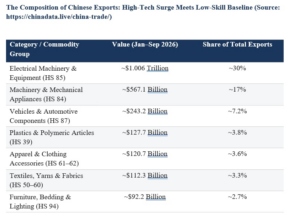
As a matter of fact, China is still a developing country, and thus, part of the Chinese labour force is still employed in what is called “low value” industries such as apparel, accessories, and plastics. But due to the very high production efficiency, of the Chinese industrial system and supply chains and the high demand internationally, Chinese goods can still compete in the global market of these low value goods too. However, this category is gradually diminishing in the Chinese economy, something the authors of the China Squeeze admit, and is being replaced by higher-value goods, as is evident in the change in the value of the different categories of Chinese exports (see figure below).
Developing industrial economies like India and ASEAN (who are the intended psychological warfare targets if the latest China squeeze narrative) need to adjust their productive capabilities the same way China has done through focus on education, research and development, and investment in high technology to escape the middle-income trap. President Xi Jinping warned as early as 2015 against falling into this trap and mobilized the nation to move from a high quantity to a high-quality innovative economy. These other nations can, then, contribute to the global development that China is spearheading almost alone. As the Chinese saying goes, the ocean is big enough to take all rivers. The global economy, especially in the Global South will not only grow, but will grow in a non-linear fashion as the means of production and technology become increasingly affordable and available for everyone and every nation.
Chinese manufacturing for the Chinese market
Another urban legend that needs to be debunked is that China’s economy depends totally on exports. The reality is that in 2025, an estimated 80% to 85% of China’s manufacturing output was absorbed by its domestic market, with only about 20% to 15% exported. This high domestic absorption varies by sector: roughly 80% of automobiles were sold domestically and only about 20% exported. About 60% of laptops relied on domestic sales. This pattern highlights China’s manufacturing base as increasingly driven by internal circulation rather than being solely an export platform. A common challenge in measuring the manufacturing dynamics is that the statistics, as above, focus on finished goods, rather than components produced and consumed domestically by industries both traditional and advanced, and in machinery for infrastructure construction.
Now, compare China’s 15-20 % of export quota to Germany! In 2015, Germany’s manufacturing export quota (the share of manufacturing goods exported relative to total sales/production) reached approximately 50%. This means that for every €100 of manufacturing goods produced or sold by German companies, about €50 was exported to foreign markets, leaving the other €50 to be consumed domestically. According to German government data, “the foreign trade balance showed a surplus of 247.8 billion euros in 2015, which was the highest value ever recorded.” It proudly added: “It clearly exceeded the previous year’s peak of 213.6 billion euros.” This was, for German politicians, a matter of pride, not shame. No protests were heard then in the EU nor in China complaining about “German overcapacity”.
Section two: The next shock
Not only is China providing affordable goods to the Global South nations but has been actively relocating the production of the same to other parts of the Global South. This case illustrates how Chinese investments are helping integrate Egypt, Morrocco, Ethiopia, and Tanzania (as examples) into emerging manufacturing sectors such as electric vehicle supply chains rather than displacing local industry.
1. Egypt
In October 2026, Egypt launched the production line of its first locally assembled electric vehicle, the Dongfeng MAGE EV, a fully electric SUV produced through cooperation between state-owned Egyptian company El Nasr Automotive, SN Automotive, and the Chinese manufacturer Dongfeng. The vehicle production was launched with 45% local content, indicating significant domestic participation in manufacturing and component production. Egyptian Industry Minister Khaled Hashem described the project as part of a broader strategy to build a competitive national automotive industry capable of participating in the global transition toward electric mobility.
The project is linked to Egypt’s efforts to develop an integrated automotive manufacturing base and strengthen its position within international supply chains. Through the government’s Automotive Industry Development Programme (AIDP). Egyptian authorities have emphasized that the objective extends beyond vehicle assembly to the development of local component industries, technology transfer, and workforce skills. The partnership with Dongfeng is presented as a mechanism for transferring industrial knowledge and expanding domestic manufacturing capabilities, while supporting Egypt’s ambition to increase local content, reduce import dependence, create skilled employment, and build an export-oriented automotive sector.
Chinese investments in Egypt recent years have reached more than US$10 billion. In the country which has a growing population (108 million in 2025) and which became a BRICS member in 2024, this is a major contribution to the government plans.
The sectors into which the Chinese investments were directed are of interest. Here is summary of the largest investments:
In advanced manufacturing and heavy industry, Egypt is home to Jushi Egypt, Africa’s largest fiberglass production base. Backed by roughly $1 billion in Chinese investment, it produces 360,000 metric tons annually, primarily exported to Western markets. Xinxing Ductile Iron Pipes manufactures large-scale water pipeline networks in Egypt, while a new $2 billion integrated aluminum industrial complex is under development in the Suez Canal Economic Zone (SCZONE). China’s Sailun Group ($1 billion project) and Linglong Tire ($2 billion complex) have signed landmark agreements to build tire and conveyor belt manufacturing lines inside Egypt to feed the local automotive ecosystem. In addition, China’s XinFeng Steel (Hebei Xinfeng) is developing major integrated steel and metal production complexes anchored in the Suez Canal Economic Zone (Ain Sokhna), under a multi-phase complex backed by Chinese-Egyptian agreements spanning from $1.65 billion up to $10 billion, depending on the scope of the broader industrial expansion.
In consumer electronics and home appliances, brands like OPPO and Transsion (Infinix/Tecno) have established major assembly hubs within Egypt, and OPPO’s electronics facility in Cairo employs over 1,000 local workers. Chinese electronics giants Midea and Haier operate large local appliance manufacturing plants, and the Chinese Hurricane Group is establishing a localized smart logistics and consumer appliance manufacturing zone.
In agriculture and renewable energy, an Egyptian-Chinese corporate alliance launched a $7 billion project to cultivate one million acres in the New Valley Governorate, implementing modern Chinese vertical irrigation and yield-enhancement technologies. China is also investing heavily in Egypt’s clean energy shift, including solar panel production lines, wind components, and green hydrogen projects along the Suez Canal.
Taken together, these sectors show that Chinese capital is flowing into Egypt’s productive base rather than into low-value assembly alone. These developments are not the finish line but the starting point for deeper cooperation, which will only accelerate, especially after the state visit made by President Xi Jinping to Egypt in September 2026.
A few revealing words about the Egyptian textile industry.
The story of the rise, demise, and rejuvenation of the Egyptian textile industry is quite revealing as to the experience and direction of events in some Global South countries. The Egyptian textile industry, based on the historically famous long-staple Egyptian cotton, became a great success after the 1952 republican revolution against British- influenced monarchy and the reforms made by the state in the 1960s. It was modernized and protected. However, it was the Western model of liberalization under harsh conditions of the IMF that brought it to its knees and the edge of extinction, to be revived again through state-backed interventions.
Between 1990 and the early 2000s, Egypt shifted from state-led textile development toward market-oriented reforms. The 1991 liberalization program restructured or privatized public enterprises, reduced trade barriers, encouraged private investment, and removed state controls over cotton production, marketing, and exports. The end of the global textile quota system in 2005 mandated by the World Trade Organization (WTO) intensified competition from efficient Asian manufacturers, particularly China, threatening employment, exports, and domestic firms. The protected industry declined and hundreds of factories were abandoned physically to rust and gather dust.
Since the 2010s, Egypt has pursued a process of state-backed modernization, restructuring major textile enterprises, especially the El-Mahalla al-Kubra complexes, and investing in machinery, automation, and production technology. The program sought to strengthen the cotton-to-garment value chain, develop industrial zones, and improve export infrastructure. Its goal has been to replace aging factories and low-value production with higher productivity and value-added exports. Textiles remain central to employment, foreign exchange earnings, and Egypt’s ambition to become a manufacturing hub linking African, European, Middle Eastern, and American markets.
Chinese investments were part of this development. Major textile and apparel projects in the Suez Canal Economic Zone, were started by Chinese firms, establishing integrated spinning, weaving, fabric, and garment operations, attracted by low labor costs, strategic location, and preferential market access. Chinese investors highlight Egypt’s growing role as a manufacturing platform for Chinese companies diversifying production and accessing global markets.
The case of the Egyptian textile industry shows that Chinese capital can expand existing industries’ productive capacity, support technology transfer, and strengthen export integration rather than simply displacing local production.
Rather than being unsuspecting minors, as Western narratives suggest, Egyptians have agency and clear awareness of the hazards of being simply assembly line operators for foreign companies, including Chinese companies. In every contract with Chinese companies, the Egyptian side requires the inclusion if locally sourced raw materials and input goods in the production line.
2. Morocco
Chinese investments and technology transfers in Morocco have surpassed $10 billion, turning the country into a massive manufacturing hub. This growth is heavily driven by the Mohammed VI Tangier Tech City, a giant industrial zone used as a trade bridge into Europe and the United States.
The main industries using Chinese capital and technology show that Morocco is moving up the value chain rather than serving as a mere assembly site. Morocco is becoming Africa’s premier electric vehicle battery supply chain hub. Gotion High-Tech is building a $1.3 billion EV battery gigafactory in Kénitra to supply the European market. CNGR Advanced Material has partnered with Morocco’s Al Mada fund for a $2 billion battery materials facility in Jorf Lasfar, and BTR New Material Group and Ingin Auto are setting up factories in Tangier Tech to make battery anodes and smart car parts.
Beyond batteries, Chinese firms are anchoring car parts and heavy industry. CITIC Dicastal operates a highly automated $200 million factory making aluminum wheels for global car brands, and Qingdao Sentury Tire has built a $300 million tire manufacturing plant in Tangier. In renewable energy, SEPCO III helped build the famous Noor Ouarzazate Solar Complex, one of the world’s largest solar installations, while Aeolon is opening a major factory in Nador to build massive wind turbine blades for export.
Chinese involvement also extends to logistics, telecommunications, finance and pharmaceuticals. Huawei uses the Tangier Med Port Complex as its regional data center and logistics hub for North and West Africa, and China Communications Construction Company (CCCC) collaborates with Casablanca Finance City to finance regional infrastructure projects. Dreaming Care and other Chinese drug firms are transferring technology to Morocco to manufacture active medicine ingredients locally.
Taken together, these examples illustrate the article’s central point: Chinese capital and technology are helping Morocco build advanced, both export-oriented and local market provider industries rather than being confined to low-value production.
3. Ethiopia
Ethiopia, another new member of the BRICS, has established a comprehensive network of public and private industrial parks—most of which have been upgraded to Special Economic Zones (SEZs). This network heavily relies on Chinese infrastructure engineering, direct capital investments, and intensive technology transfers. The recent four five-year plans have greatly contributed to making the country the fastest growing in Africa. The government’s focus on building large-scale hydropower, with a relatively large Chinese support, transport infrastructure, and agricultural reform have had a great impact on the development process. Thanks to the Chinese built Djibouti-Addis Ababa railway and the large-scale expansion of the port facilities in Djibouti, the 140 million people in landlocked are now connected to the global market. Below is a detailed breakdown of Chinese operations, infrastructure, and technology deployments across these zones.
The government-built Special Economic Zones and industrial parks managed by the Industrial Parks Development Corporation (IPDC) are the backbone of this network. Hawassa Industrial Park, built entirely by the China Civil Engineering Construction Corporation (CCECC), serves as a textile mega-hub. A key example is Wuxi Jinmao, a major Chinese textile supplier that established a high-tech textile mill there after providing extensive technical training to Ethiopian university graduates at its headquarters in China. Bole Lemi Industrial Park, just outside Addis Ababa, had its phase II extension awarded to the CGCOC Group (formerly China Geo-Engineering Corporation). It is a premier location for tech hardware and garment assembly and has attracted Chinese firms like Wenzhou Nixin Trading to build multi-million dollar paper and aluminum facilities. Kilinto Industrial Park, engineered and constructed by CTCE (a subsidiary of China Railway) for $240 million, is designated as a pharmaceutical and medical manufacturing zone, where Chinese cosmetic and medical packaging companies are investing millions in advanced factories.
Along the Addis Ababa-Djibouti trade corridor, Adama Industrial Park, also built by CCECC, focuses on textiles and heavy equipment manufacturing, using Chinese machinery and production lines to process local agricultural inputs into global exports. In the north, Kombolcha Industrial Park, developed by CCECC, is a textile and light electronics cluster that integrates Chinese supply chain logistics for large-scale clothing manufacturing. Jimma Industrial Park, constructed by the China Communications Construction Company (CCCC) for $66 million, leverages Chinese agro-processing equipment to wash, roast, pack, and export high-grade Ethiopian coffee and agricultural goods with modern quality-control technology. Mekelle Industrial Park is another major textile hub built by CCECC, with modern, pre-built industrial sheds designed to match East Asian factory templates, which facilitates quick technology replication. Dire Dawa Free Trade Zone and SEZ is home to integrated logistics technology, with a smart customs infrastructure developed by Chinese construction firms, making it Ethiopia’s premier dry-port trading post connecting local factories to shipping routes via the Chinese-built railway. The regional parks in Debre Birhan and Bahir Dar host Chinese agro-industrialists and textile manufacturers, focusing on specialized spinning, garment weaving, and food processing technologies.
Private and corporate zones complement the state-built parks. The Eastern Industrial Zone in Dukem, the pioneering Chinese-developed private park launched by the Jiangsu Qiyuan Group, hosts over 130 firms and has been the cradle of heavy technology transfers, including Lifan Motors (automotive assembly), Sansheng Pharmaceuticals (advanced drug formulation), and Dires Ceramic (heavy building materials). The Huajian International Light Industry City in Addis Ababa, built by the Huajian Group, is a prime model for automated footwear production technology in Africa, manufacturing 15,000 pairs of shoes daily and providing comprehensive vocational training to thousands of local workers. Dongfang Industrial Park, privately funded and developed by Jiangsu Yongyuan Investment Co., mimics the small-to-medium enterprise (SME) incubation zones of China’s coastal provinces and provides localized power infrastructure and machinery setups for manufacturing components.
These parks show Ethiopia acquiring industrial skills, equipment and know-how across textiles, pharmaceuticals, agro-processing and heavy industry, not merely hosting low-value assembly.
Over the past five years (2021–2025), Ethiopia’s economy has consistently ranked among the fastest-growing in Sub-Saharan Africa, achieving a cumulative real GDP expansion of roughly 39% that culminated in a rebased nominal output of $210.7 billion by 2025. This rapid momentum was primarily fueled by three critical growth drivers: heavy capital investments in state-managed infrastructure and Special Economic Zones that accelerated light manufacturing; a major push in modernizing agriculture through widespread summer irrigation programs and optimized supply chains; and the exponential expansion of domestic fintech platforms and mobile money networks that digitalized the broader economy. It is important to emphasize this development is part and parcel an Ethiopian-planned and implemented policy, showing agency and genuine mission orientation. However, in synergy with China and the Belt and Road Initiative, this development process is accelerating
4. Tanzania
Tanzania’s investment landscape has experienced a major structural shift, capturing $68.6 billion across 3,538 registered projects. The state merged its investment bodies into a single, comprehensive one-stop center called the Tanzania Investment and Special Economic Zones Authority (TISEZA).
Similar to Egypt and Ethiopia, Tanzania is rapidly moving its economic center of gravity away from raw mineral extraction and toward large-scale manufacturing. China is the dominant driver of this transformation, accounting for $14.1 billion in total capital and backing more than 90% of all recent Special Economic Zone (SEZ). investments.
Investment in Tanzania is concentrated in a few core sectors. Manufacturing is the primary focus, accounting for 30% of all registered national projects, and is heavily clustered in steel mills, cement, industrial textiles, and consumer electronics. Agro-processing and value addition are also receiving major pushes, in cashew nut processing, commercial avocado packaging (exports hit 52,000 tonnes), and large-scale fisheries finance. In energy and natural gas, new gas discoveries exceeding 200 billion cubic feet at Mnazi Bay come alongside massive, underutilized wind, solar, and geothermal reserves, while infrastructure and real estate are fueled by a commercial housing shortage of 3.8 million units and the expansion of deep-water port logistics.
Tanzania also operates an aggressive economic zone strategy, including a pipeline to build 26 new regional industrial parks. The primary active hubs are the Bagamoyo Eco-Maritime City, a $3 billion, 9,000-hectare mega-project 50km north of Dar es Salaam that is to serve as a principal manufacturing and shipping base linked to regional trade routes; the Sino-Tanzania Kwala SEZ, an inland dry-port industrial zone integrated with the new Standard Gauge Railway (SGR) network to move manufactured goods efficiently; the Benjamin William Mkapa SEZ, the main state-run urban industrial park in Dar es Salaam, focused on export-oriented light manufacturing and garment assembly; the Nala SEZ in Dodoma, a 607-hectare hub specializing in agricultural fertilizers and heavy commercial processing plants; and the Buzwagi SEZ, a 1,333-hectare zone designed to convert older mining concession areas into diversified industrial clusters.
As in Egypt, Morocco and Ethiopia, the pattern is the same: Tanzania is using Chinese capital and technology within its own industrial strategy to climb from raw materials toward manufacturing, rather than being locked into low-value production. These industrial projects are directly connected to Belt and Road infrastructure projects such as the Tanzania-Zambia Railway. African nations are also working together to enhance their infrastructure investments. Earlier this year, two Egyptian construction companies and their Tanzanian counterparts completed one of the largest hydropower projects in the continent depending on their own domestic capabilities, the Julius Nyerere 2115 megawatt dam and hydropower plant.
Why would this become a new shock?
The developments in these four countries, which is also taking place also in other countries all across Africa, should not be a shock for anyone. While Africa is still relatively poor, it is important to view the trajectory of where Africa is heading. But like in the case of China’s rise, Europeans and Americans are completely oblivious to what is taking place on the continent or are ignoring it because it involves China. One day they wake up to find out that African companies have leapfrogged European companies in certain sectors and would react in panic. This already happened once when the EU realized that the Egyptian partner of China’s Jushi started to outcompete European glass fiber producers in the European market. In 2020, the EU Commission imposed, and still maintains, combined anti-dumping duty of 11% plus an anti-subsidy duty of 13% (totally 24%) on glass fiber products from Jushi Egypt. Ironically this tariff did not prevent European competitors from going bankrupt and only made the product more expensive in the European market. Now, this is gradually becoming an issue for multiple advanced products such EVs, batteries, drones, and other products made in Morrocco and Egypt. Europe should wake up now, not by blocking products from these countries, but by rebuilding its infrastructure, education, and industrial and technological capacity. History has not ended. It is an evolutionary process on multiple and interconnected levels.
Conclusion
Viewed from the Global South, the “China Squeeze” narrative mistakes competition within existing markets for a barrier to development. It assumes that poorer countries must wait for China to abandon basic manufacturing before they can industrialize. The cases examined here point instead to a possibility: expanding productive capacity through infrastructure, affordable technology, investment, and skills development.
Egypt, Morocco, Ethiopia, and Tanzania illustrate how cooperation with Chinese firms can support local manufacturing, strengthen supply chains, and open opportunities beyond raw material exports. These opportunities span both traditional industries, such as textiles, and emerging sectors, including electric vehicle components and renewable energy. The relevant question is therefore not whether China still produces shoes or clothing, but whether developing nations can acquire the capabilities to produce more, better, and at higher value.
This does not mean that every investment guarantee development. National agency, local content, technology transfer, and effective industrial policy remain essential. But the material challenges the claim that China closes the industrial ladder behind it. From a Global South perspective, the priority should be to harness and emulate productive advances, not obstruct them. Development is not the redistribution of a fixed industrial pie; it is the deliberate expansion of productive possibilities.
What the public, researchers, and policy makers in the United States and the EU need to realize is that the conceptual frame of thinking which is dominant in the West in recent decades, i.e. zero-sum game and British imperial-originated geopolitical mindset, is the source of danger to their societies and to prosperity, peace, and security on the globe.
Joining China today in such efforts as the Belt and Road Initiative, is the best and most reasonable step the EU and the U.S. can take to remedy many ills caused internally and externally. By democratizing technology, ending centuries of technological apartheid, China is contributing to the common good by unleashing the creative powers and potentials of hundreds of millions of young Africans and Asians. Standing with China, rather than blocking its way and smearing its efforts with such narratives as the “China squeeze”, is the reasonable and moral choice for today. If not, at least, as the saying goes, he who says ‘it cannot be done’ should not stand in the way of the one doing it.
Related items:
Debunking the Chinese ‘debt-trap’ narrative in 3 steps: new research method
A Blueprint for Peace through Development in West Asia and Africa: New Report!