

Li Xing* and Zhang Jiuan**
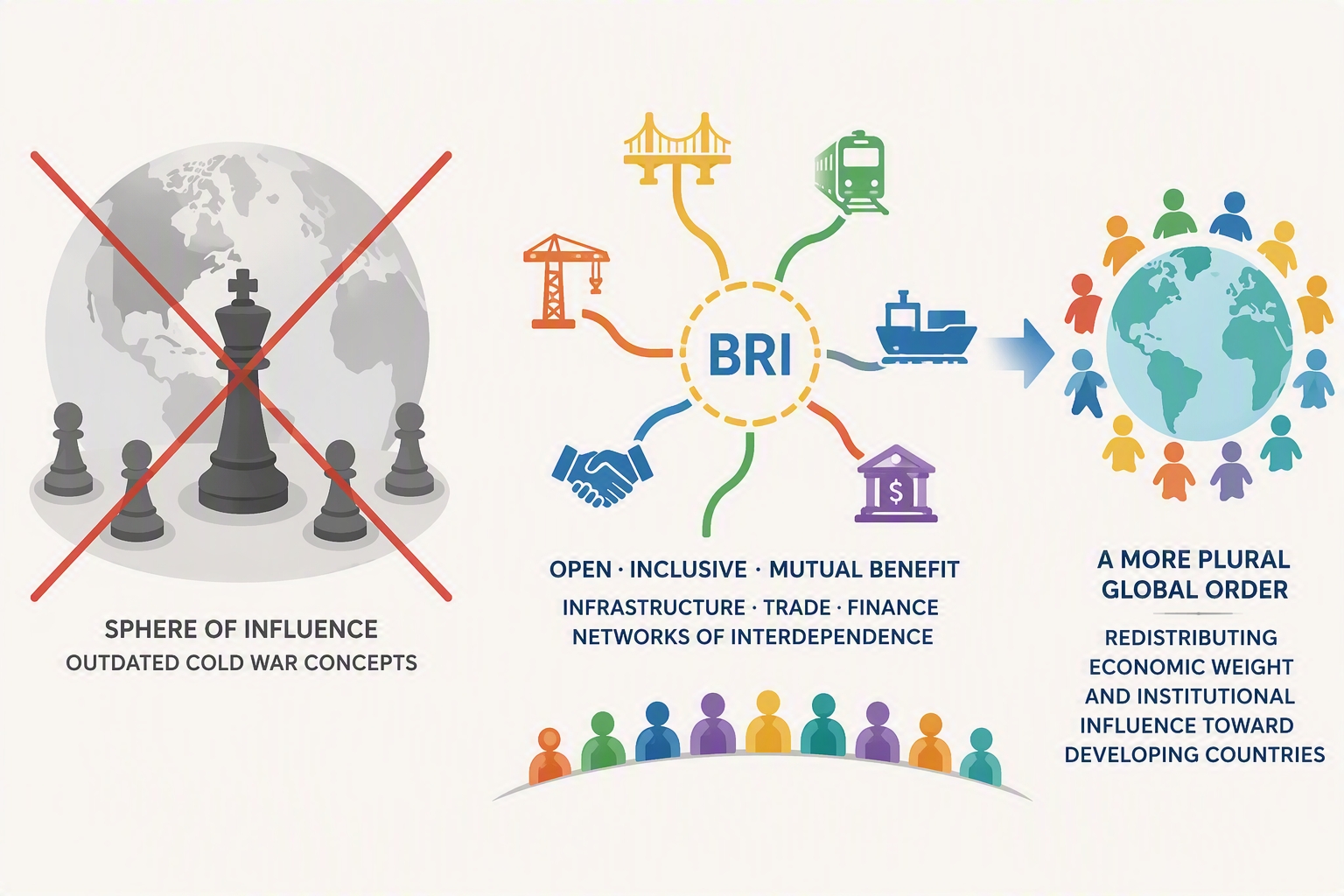
This article challenges the view that China’s Belt and Road Initiative (BRI) is a sphere-of-influence project. The authors argue that such interpretations rely on outdated Cold War concepts. Instead, the BRI is an open framework that deepens economic ties with the Global South while promoting sovereignty, mutual benefit, and development. Through infrastructure, trade, and finance, it builds networks of interdependence rather than territorial control. The BRI’s real significance lies in redistributing economic weight and institutional influence toward developing countries, contributing to a more plural global order.
Introduction: Rethinking the Belt and Road Initiative
The Belt and Road Initiative (BRI) has become one of the most consequential components of China’s engagement with the developing world. Since its launch in 2013, it has expanded from infrastructure connectivity into a broad framework encompassing trade, investment, finance, industrial cooperation, energy, digital connectivity, health, and institutional cooperation across Asia, Africa, Latin America, the Middle East, and parts of Europe.
Yet the BRI has also become one of the most contested international initiatives of the 21st century. In much Western political and academic discourse, its expansion has frequently been interpreted through the familiar concept of a “sphere of influence”: China is seen as using infrastructure, trade, finance and investment to create political dependence, expand geopolitical influence, and ultimately establish a China-centered sphere of influence across the Global South.
There is undoubtedly a strategic dimension to China’s international economic engagement. China does not hide its interests in markets, resources, technological opportunities, connectivity, energy security, and a greater voice in international institutions. The BRI also enhances China’s economic and diplomatic influence. But recognizing the influence brought about by the BRI does not necessarily establish the existence of a sphere of influence. The two concepts should not be treated as synonymous.
The distinction matters because the concept of sphere of influence belongs to a particular historical conception of international order. Historically, spheres of influence were closely associated with great-power rivalry, imperial expansion, colonialism, territorial division, and hierarchical relations between dominant and subordinate states. European colonial powers divided parts of Africa, Asia and Latin America into privileged zones, while the Monroe Doctrine established the Western Hemisphere as an area in which the United States claimed special strategic authority. During the Cold War, international politics was similarly organized around competing geopolitical blocs and spheres of influence.
The persistence of this conceptual vocabulary matters because it shapes how China’s contemporary engagement with the Global South is interpreted. When Chinese infrastructure, trade, investment and diplomatic activities expand across regions historically dominated by Western powers, they are easily interpreted as an attempt to occupy a new geopolitical space. China’s BRI in Africa, for example, is sometimes presented as an intrusion into what Europe historically regarded as its sphere of influence. The same logic appears in discussions of China’s growing presence in Latin America, Southeast Asia, the Middle East and other regions.
But this interpretation raises a more fundamental question: does the BRI actually reproduce the territorial and hierarchical logic of the traditional sphere of influence, or does it represent a different form of international engagement emerging from a changing global political economy?
This article argues that the BRI should not be reduced to a Chinese attempt to establish a sphere of influence. It is better understood as a comprehensive framework through which China is deepening economic, institutional and developmental relations with the Global South while simultaneously promoting a different conception of global order — one that emphasizes sovereignty, development, connectivity, mutual benefit and greater representation for developing countries.
This does not mean that the BRI is devoid of strategic interests or that its implementation should be exempt from any concern. BRI related debates around debt sustainability, transparency, environmental consequences, labor practices and governance are legitimate. Nor does it mean that China’s expanding global influence should be ignored. The central argument is more specific: Chinese influence should not be judged through the conceptual lens of a Chinese sphere of influence.
The distinction opens a different analytical perspective. Rather than asking whether China is replacing Western influence with its own sphere of influence, we should ask what the BRI is doing to the structure of the international political economy. In particular, we should examine whether China’s growing economic relationship with the Global South is contributing to a redistribution of economic weight, development opportunities and institutional influence in the international system.
The argument therefore proceeds in three steps. First, it examines the historical and conceptual legacy of the concept of sphere of influence and explains why it has become an inadequate lens for understanding contemporary global transformation. Second, it examines the BRI as China’s comprehensive engagement with the Global South and shows why its geographical scope, economic functions and institutional forms cannot be adequately captured by the traditional sphere-of-influence framework. Third, it interprets the BRI through a global-order perspective, arguing that its deeper significance lies not simply in expanding China’s influence but in contributing to a broader reconfiguration of the world economy and the growing centrality of the Global South.
The BRI and the Geopolitical Turn in Its Interpretation
The concept of a sphere of influence refers to a situation in which a powerful state exercises privileged and often comprehensive influence over surrounding countries or regions in political, economic, military, cultural and strategic affairs. It has been one of the most persistent concepts in the history and practice of international relations. The concept is inseparable from the historical experience of great-power competition and imperialism. European colonial powers used spheres of influence to divide and manage territories in Africa, Asia and Latin America, while the United States established its own regional sphere through the Monroe Doctrine. China itself experienced the destructive consequences of this system when, following the Opium Wars, parts of its territory and economic space were divided among competing Western powers.
The concept of a sphere of influence therefore does more than describe a particular pattern of international relations. It carries with it a particular understanding of international order: great powers occupy privileged geopolitical spaces, weaker or smaller states become subordinate to the strategic interests of dominant powers, and international stability is maintained through the management and delimitation of competing spheres.
This concept was particularly visible during the Cold War, when the world was divided between competing political and military blocs. The United States and Soviet Union constructed extensive alliance systems, while Europe and other regions became arenas of superpower competition. With the collapse of the Soviet Union, however, this structure appeared to lose much of its relevance. The post-Cold War period was characterized by unprecedented American predominance, and traditional great-power competition appeared temporarily diminished.
The contemporary international system is different. The decline of unipolarity, China’s rise, Russia’s renewed geopolitical weight, the European Union’s search for strategic autonomy, the emergence of “middle powers,” and the increasing agency of the Global South all indicate a transition toward a more complex and multipolar international environment.
It is precisely in this transitional environment that the concept of a sphere of influence has returned to prominence. As China’s economic and political presence has expanded, Western governments and analysts have increasingly interpreted its activities through the vocabulary of geopolitical competition: Chinese infrastructure in Africa is perceived as an extension of Chinese strategic influence; Chinese investment in Latin America is seen as a challenge to the United States’ traditional position in the Western Hemisphere; and China’s connectivity projects in Asia are interpreted as evidence of an attempt to construct a China-centered regional order.
Such interpretations are rooted in the standpoint of traditional great-power geopolitics. Yet they risk reproducing an older conceptual map of international relations at a time when the global structure of the world economy is changing. The central problem is that the lens of the sphere of influence framework tends to treat international regions as geopolitical spaces to be controlled rather than as networks of economic, social and institutional relationships in which states retain agency and pursue multiple partnerships simultaneously.
This distinction becomes particularly important in the case of Global South. Many developing countries do not treat their relationships with China simply as choices between competing great powers. They seek infrastructure, investment, technology, markets, industrial development and greater international representation. They frequently maintain relationships with China, the United States, Europe, Japan, India and other powers simultaneously. The central question, therefore, should not be whether China’s BRI constitutes “influence.” It clearly does. The more important question is what kind of influence is being generated by the BRI, through what mechanisms, and with what consequences for the wider international order.
The BRI as an Open and Inclusive Initiative
Announced by President Xi Jinping in 2013, the BRI was initially framed around the Silk Road Economic Belt and the twenty-first-century Maritime Silk Road. Its stated objectives included infrastructure development, connectivity, trade facilitation, investment, economic cooperation and mutual development. The 2015 policy document emphasized “peace, development, cooperation, and mutual benefit” and presented the initiative as an inclusive framework for international economic cooperation.
The BRI subsequently expanded far beyond traditional infrastructure. It now encompasses railways, highways, ports, energy systems, industrial parks, logistics networks, digital communication, telecommunications, health cooperation and other forms of economic and technological interaction. It therefore represents not one project but a broad platform through which China connects its economy with a large part of the developing world.
From an international political economy perspective, the BRI serves multiple Chinese objectives. It creates markets for Chinese goods and services, internationalizes Chinese firms and financial institutions, supports industrial development, strengthens energy security, diversifies transportation routes, and creates new channels of international economic cooperation. It also increases China’s diplomatic and institutional presence. These interests should not be denied. Indeed, no country engages internationally without pursuing its own interests. The analytical mistake is to assume that China’s pursuit of these interests necessarily means that it has an agenda to transform the BRI into a sphere-of-influence project.
The distinction between “influence” and “sphere of influence” is therefore crucial. Influence can be generated through trade, investment, connectivity, technological cooperation and institutional relationships without producing exclusive political control over a geographical region. Sphere of influence, by contrast, implies privileged authority and control, as well as a degree of geopolitical exclusivity.
At its point of departure, the BRI was conceived as an open and inclusive project, welcoming participation and cooperation from countries and institutions around the world. John Thornton, former president of Goldman Sachs and chair emeritus of the Brookings Institution, has recounted that Chinese President Xi Jinping welcomed and encouraged American participation in the Belt and Road Initiative during a 2013 conversation with a U.S. delegation led by then-Secretary of State John Kerry. According to Thornton’s account, Kerry was initially receptive to the prospect of such collaboration. However, a senior U.S. Treasury official subsequently declined the proposal before the delegation returned to Washington. This indicates the fact that, from its very beginning, the BRI was open to the US participation and cooperation.
Countries participating in the BRI continue to maintain relationships with other major powers. They do not necessarily abandon Western markets, institutions or security relationships when they deepen economic cooperation with China. Indeed, the Global South increasingly uses relationships with multiple major powers to expand its own room for maneuver.
This is particularly important because many developing countries face enormous infrastructure and development deficits. Chinese financing has frequently been welcomed as an additional source of infrastructure investment, particularly where funding gaps remain substantial and where Western development institutions have not provided sufficient resources.
The controversies surrounding the BRI should nevertheless be taken seriously. Critics have raised concerns about debt sustainability, environmental degradation, governance standards, labor practices, transparency, and the possibility of creating economic dependency. The so-called “debt diplomacy” argument has been particularly influential in Western policy and academic debates. Yet such claims should be evaluated empirically rather than inferred simply from the existence of Chinese lending. Empirical studies indicate that, in frequently cited cases such as Sri Lanka and Kenya, Chinese loans have constituted only a relatively small proportion of total external debt. A substantial share of their external debt is instead owed to Western-dominated and market-based financial institutions, including commercial creditors and multilateral financial institutions. This suggests that the causes of debt distress and financial vulnerability in these cases cannot be attributed to Chinese lending alone and must be situated within the broader structure of the international financial system.
One of its most significant consequences is the changing structure of China’s relationship with the Global South. As China rises, the Global South is becoming more prominent alongside it. China’s trade with developing countries has expanded to such an extent that the Global South is no longer peripheral to China’s international economic strategy. China is Africa’s largest single-country trading partner, with China-Africa trade reaching roughly $295 billion in 2024–25. China-ASEAN trade exceeded $980 billion in 2024. These relationships increasingly demonstrate the growing weight of South-South economic relations in the world economy.
This development is analytically more important than the question of whether China is acquiring influence in particular countries. The deeper transformation is structural: China is becoming increasingly embedded in the production networks, markets, infrastructure systems, and development trajectories of the Global South, while the Global South itself is becoming increasingly important to China’s economic development.
This relationship is therefore not adequately represented by a simple model of China at the center and dependent countries at the periphery. It is better understood as a growing network of economic interdependence in which both China and developing countries acquire new opportunities and new forms of dependence. This is where the BRI begins to acquire significance beyond Chinese foreign policy. It becomes part of a broader transformation of the world economy.
From the BRI to Global-Order Transformation
If the BRI is not adequately understood as a sphere of influence, the next question is: what kind of international order is it helping to produce?
The answer requires changes in international ordermoving from a geopolitical perspective to a global-order perspective. The BRI can be understood as both narrative and practice. Narratively, it invokes the historical imagery of the Silk Road, connectivity, exchange and shared prosperity. It is linked to broader Chinese concepts such as the “Community of Common Destiny for Mankind,” Tianxia and Hehe, which present development, connectivity and cooperation as components of a broader conception of international relations.
In practice, these ideas are translated into infrastructure, finance, trade, industrial cooperation and institutions. The Asian Infrastructure Investment Bank (AIIB), bilateral agreements, economic corridors, ports, railways, energy systems and digital networks provide material mechanisms through which China’s conception of international cooperation is embedded in concrete relationships. The relationship between China’s material capabilities, principles and practices can be captured through a Power–Principles–Practices (PPP) framework.
Power provides the material foundation. China’s enormous industrial capacity, financial resources, technological capabilities and position within global production networks enable it to undertake large-scale international economic projects. Principles provide a normative framework. The BRI emphasizes sovereignty, mutual benefit, development, connectivity and cooperation, while China’s broader international discourse promotes the idea of a Community of Common Destiny for Mankind. Practices translate these material and normative resources into institutions and projects. AIIB financing, economic corridors, infrastructure construction, trade agreements, industrial cooperation and digital connectivity create durable relationships between China and its partners.
The significance of the PPP framework is not simply that it describes the BRI. It helps explain how a rising power can contribute to changes in the international order. Power without principles may generate coercion; principles without material capabilities may remain rhetorical; and practices without a broader normative framework may remain fragmented. The interaction of the three allows China to translate economic capabilities into institutional and normative influence.
From this perspective, the BRI can be understood as a form of relational power. China does not need to establish direct political control over other countries in order to become more influential. Its influence emerges through networks of trade, infrastructure, finance, technology, industrial production and institutional cooperation. This is fundamentally different from the territorial logic of a conventional sphere of influence.
The distinction becomes particularly significant when considering the changing position of the Global South. China’s rise is not simply a story of a previously peripheral country moving toward the center of an existing world economy. China’s growing relationship with developing countries is simultaneously strengthening the position of those countries within global production, trade and demand networks. The manuscript’s evidence suggests that China’s economic engagement with the Global South has become sufficiently extensive that developing countries are increasingly central rather than peripheral to China’s own economic development.
The implication is important. The BRI does not operate only as a mechanism for projecting Chinese power outward. It also contributes to the restructuring of the economic environment in which China and the Global South interact.
China’s industrial capacity creates complementarities with developing countries in resources, labor, markets and infrastructure. Developing countries provide resources and expanding markets, while China provides manufacturing capacity, infrastructure, technology, investment and connectivity. As these relationships deepen, the economic center of gravity of the world system gradually becomes more dispersed.
This does not mean that the BRI has created an equal global order. Significant asymmetries remain between China and many developing countries. Nor does it mean that Chinese interests and Global South interests always coincide. International economic relationships inevitably involve bargaining, competition and unequal capabilities.
The argument is instead that the BRI contributes to a more plural distribution of economic and institutional power. It creates additional choices for developing countries, expands South-South economic relations, strengthens connectivity among regions of the Global South and challenges the assumption that development, finance and institutional authority must flow primarily from Western centers to developing peripheries.
In this sense, the BRI should be understood as part of a broader transition from a historically hierarchical global economy toward a more complex and plural one.
Conclusion: Reassessing the BRI Beyond Geopolitics
The debate over the Belt and Road Initiative reveals a broader problem in contemporary Western interpretations of China’s rise. Viewing the BRI primarily through the concept of a sphere of influence assumes that international politics remains fundamentally a competition among great powers for exclusive geopolitical space. This perspective overlooks the changing structure of the world economy, the growing agency of Global South, and the increasingly networked nature of international relations.
More than 13 years after its launch, there is little empirical evidence that such a sphere has emerged. Although China has substantially expanded its economic, diplomatic, and infrastructure engagement across the Global South, these relationships have not translated into exclusive political alignment or Chinese control. BRI partner countries continue to maintain diverse and often overlapping economic, diplomatic, and security relationships with the United States, Europe, Japan, India, and other major powers.
The more consequential question is what the BRI means for the evolving global order. Through infrastructure, trade, investment, industrial cooperation and institutional connectivity, the BRI has helped deepen China’s relations with the Global South while strengthening the latter’s position within global economic networks. Its significance therefore extends beyond China’s acquisition of influence. It is part of a broader redistribution of economic weight, development opportunities and institutional agency that is making the Global South increasingly central to the international system.
For the West, this calls for a shift from an analytical perspective. The BRI should neither be idealized nor treated uncritically; its projects should remain subject to scrutiny concerning sustainability, transparency and local interests. But such scrutiny should not begin with the assumption that every Chinese initiative represents geopolitical expansion. The more productive question is not whose sphere of influence the BRI will create, but what kind of global order its expanding networks are helping to produce. Seen from this perspective, the BRI is less a project for dividing the world into competing spheres than one element of the ongoing struggle to define a more plural, inclusive and equitable international order.
* LI Xing is a Yunshan leading scholar and the director of the Centre for European Studies at Guangdong Institute for International Strategies, Guangdong University of Foreign Studies, and an adjunct professor of international relations at Aalborg University, Denmark.
** ZHANG Jiuan is a research fellow, Academy of Contemporary China and World Studies.