
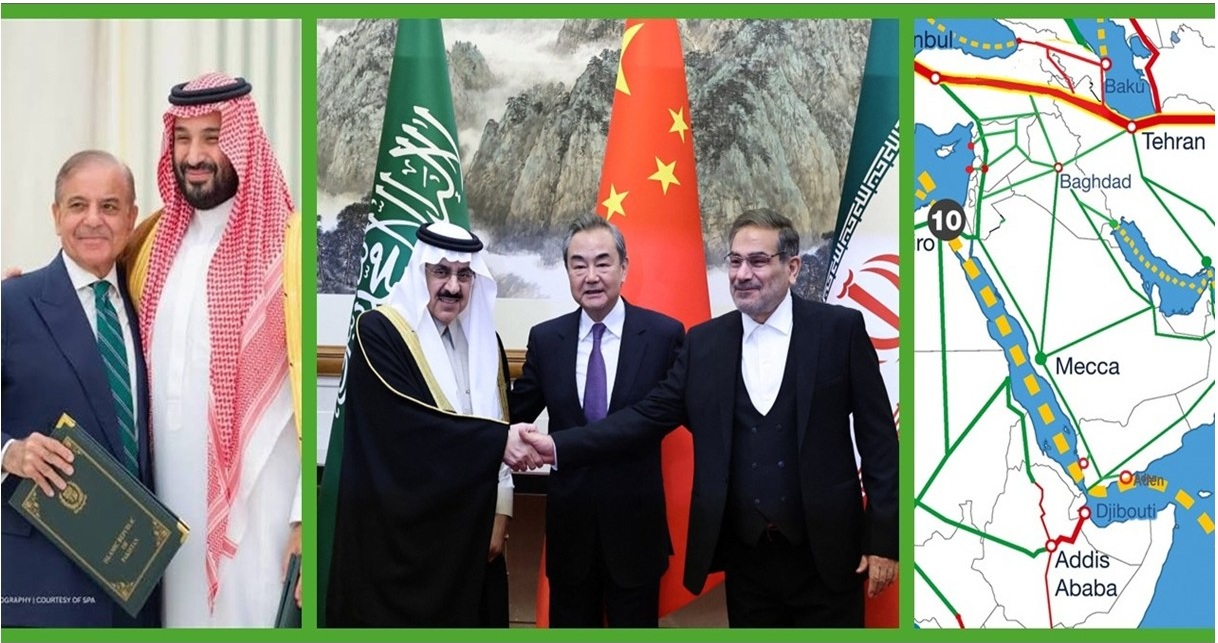

Based on the new realities created by the expansion of the Belt and Road Initiative as a successful model for “peace through economic cooperation” and the recent failure of the United States Administration and Israel in bringing about a regime change in the Islamic Republic of Iran through a war of aggression, new possibilities have emerged for a new “security architecture” in the region of West Asia. The role of Pakistan, Iran, Saudi Arabia, Egypt, and Türkiye will be decisive in achieving this goal.
The “Mohammad Accords” is a concept minted by Hussein Askary, economic and strategic analyst and Vice-Chairman of the Belt and Road Institute in Sweden. He first expressed it on Pakistan TV on June 14, following the announcement by Pakistan’s Prime Minister Shahbaz Sharif that an agreement was reached by the United States and Islamic Republic of Iran. A further elaboration of the concept was made after the subsequent signing of the Islamabad Memorandum of Understanding ending the second U.S.-Israeli war on Iran (launched in February 2026) between the U.S. President Donald Trump and Iranian President Masoud Pezeshkian on June 17, 2026. Pakistan and Prime Minister Shahbaz Sharif played the key mediator role to reach this ceasefire agreement.
The term “Mohammad Accords” is based on the name of the Prophet of Islam Mohammad. It mimics the “Abraham Accords” initiated during the first Trump Administration in September 2020 with the aim of reaching a full normalization of relations between Israel and Arab countries without the Palestinian people regaining their rights and without the establishment of a two-state solution which was the condition for such normalization presented in the 2002 Arab Peace Initiative. The Abraham Accords fell into neglect as a result of the Gaza genocide initiated by the Israeli Defence Forced (IDF) in October 2023. Trump’s recent insistence that Saudi Arabia, Qatar, Turkey, and Pakistan should join the Abraham Accords was met with total disinterest by these countries.
The “Mohammad Accords” concept is derived from the analysis of several indicators over the past 12 years, but most emphatically since 2022:
- The failure of the U.S.-Israeli war on Iran in 2025-2026, making the massive military power and hardware of the U.S. obsolete through Iran’s use of asymmetrical weapons systems, such as drones, ballistic and hypersonic missiles. Iran also effectively used geography, the closure of the Hormuz Strait, as the most effective weapon to force the Trump Administration to end the war to avoid a 1929-style global economic depression which will be blamed on Trump himself.
- The failure of the U.S. to defend its military basis in Arab countries and “protecting” these countries from Iranian attacks. Having American bases on their soil became a liability and source of danger for these countries rather than a source of security. This is prompting the Gulf countries to look for alternative security mechanism.
- The decisive role played by Pakistan, Egypt, Türkiye, Saudi Arabia, and Qatar in bringing about this peaceful solution, though temporarily. This has placed these countries, especially Pakistan, into a position of trusted brokers by the countries involved in the conflict. This gives them leverage, besides their military might, to assure all parties of fair and constructive engagement.
- The global economic power shift to the East and Global South, especially to China, and the rallying of the countries in this region around the Belt and Road Initiative (BRI) as a model of cooperation and peace through development. This includes both the Gulf Cooperation Council (GCC) members and Iran who are all members of the BRI and signatories to strategic comprehensive cooperation agreements with China. The Chinese policy to “unite and prosper”, as opposed to the Anglo-American-Israeli policy of “divide and conquer”, successfully normalized diplomatic relations between Saudi Arabia and Iran in March 2023 to bridge the sectarian gap of Shia-Sunni superficial but dangerous divide. China also signed strategic comprehensive cooperation agreement with both sides in 2022 and 2023. It also helped (in cooperation with Russia) to bring them and other nations in the region closer to the Shanghai Cooperation Organisation (SCO) and BRICS which became BRICS Plus. Chinese officials have argued repeatedly that the security of the region should be managed by the peoples of the region, not outside forces.
- The failure of both economic and security models of the gulf countries.
On the one hand, the old economic model of the 1970s and 80s of the oil exporting countries was to generate hard currency, which is invested in a luxurious lifestyle and, because the populations are so small and real economic activities on their soil were inexistent, the resources were invested in and by Wall Street and City of London financial and banking interests. The speculative trans-Atlantic financial and banking system became a burden for these countries when it collapsed in 2008. Due to their deep integration into this system, the Gulf countries’ sovereign wealth funds were forced to bail out American, British, and European banks to avoid total bankruptcy. The global economic decline caused by the 2008 financial crisis also brought down the oil prices. That old economic model started to collapse starting in 2014 and continuing through 2023 when the oil prices went below US$60/barrel (sometimes even below US$30/barrel) for much of that period. This placed these nations in dire financial straits.
On the other hand, a great portion of the oil revenues were invested in British and American weapons systems, security, and intelligence services purportedly to protect these countries from Iran and other dangers in their neighbourhood. More resources from the Gulf countries and Iran went into feeding the proxy wars and regime change operations in Yemen, Syria, Libya, Sudan, Lebanon, and Iraq. This led to further depletion of resources and greater insecurity for all countries. This latter security model also collapsed with the recent war on Iran when the U.S. protection umbrella was effectively burned by Iranian missiles and drones.
Nations in the region had to divest from the model of dependency on oil exports for income into diversifying their sources of income through industrialization. Saudi Arabia launched the Saudi Vision 2030 for this purpose. On the other hand, the failure of the war on Iran has brought a new opportunity to disinvest in the expensive but failed Anglo-American security “shelter” model.
- The realization that the lack of a solution to the Palestinian issue, the nuclear-armed Israel and its Zionist expansionist ideology, “Greater Israel”, and the series of regime change wars in this region by the U.S., Britain and their allies are, combined, the greatest threat to peace and security in the region. Differences between Muslim nations could be resolved easily through dialogue as there are no border disputes and no conflict in management of resources. But the Palestinian issue cannot be resolved without Israel abandoning its illusions and accepting to give back the land it occupies to the Palestinian people where they can establish their Palestinian State in accordance with United Nations Security Council Resolutions and respect for international law. Israel’s own security concerns can be mitigated by all parties respecting international law and accepting to co-exist in peace. The illusion that Israel would survive as “a garden of democracy in a jungle” must be abandoned. Plans to destroy all the major military and demographic powers in the region (Syria, Iraq, Iran, Egypt, Türkiye, and Saudi Arabia) to secure Israel’s realm is a dangerous delusion which could end with the demise of Israel itself. The Arab Peace Initiative is still a viable solution that can guarantee Israel’s security but only if the Palestinian people regain their rights. This is why no Arab and Muslim country any longer accept joining the Abraham Accords.
Key general features of the Mohammad Accords
- Security in the Persian Gulf and wider West Asia region will be provided through special accords and understandings by the Muslim nations of the region. Pakistan, Türkiye, and Egypt as the largest military powers can, if necessary, provide guarantees to the smaller GCC countries and Saudi Arabia. This renders the existence of costly American and other Western bases in the region unnecessary.
- A new organisation in the Persian Gulf should replace the exclusive club of the GCC to include Iran, Iraq, and Yemen. The Persian Gulf should become a bridge among these nations rather than a Berlin Wall. Such an organisation will also deal with the management of the traffic in the Hormuz Strait.
- Efforts must be made by religious institutions in these countries to end the Shia-Sunni friction in the region. A dialogue of civilizations is to be promoted to bridge differences between East and West. This region has been the crossroads of world cultures and civilizations for thousands of years. The Chinese proposed Global Civilization Initiative is a suitable launching pad.
- “Peace through economic development” must become the norm, and investments to integrate the regions’ infrastructure systems of transport, power, and water should become a priority. The Belt and Road Initiative, the China-Pakistan Economic Corridor, the North-South International Transport Corridor, and the Oasis Plan for greening the deserts and solving the water shortage crisis proposed by the Schiller Institute should become a priority. Every nation should be allowed to benefit from civilian nuclear technology. The participation by the European Union, the United States, India, and other nations in these economic development projects is to be welcomed, but without geopolitical strings attached. A blue print for this type of global cooperation in West Asia and Africa exists in the form of a 290-page special report published by the Schiller Institute in 2026 and co-authored by Hussein Askary and Jason Ross.
- For Israel to join this new regional security architecture, it has to change its behaviour and treatment of the Palestinian people and its neighbours. The Abraham Accords are not a serious proposal as they represented a policy of dividing the nations of the region among friends and enemies of Israel. At the same time, they were meant to send the Palestinian people and their legitimate rights into oblivion. The Abraham Accords were never meant as a means of establishing peace in this region. The results speak for themselves.
The Mohammad Accords will not be an exclusive club for “Muslims-only”. In every Muslim nation, the rights of other religious minorities like Jews and Christians are protected by law. The name of Abraham, the Patriarch of all monotheistic religions (Judaism, Christianity, and Islam) would have been an appropriate name for the peace of faith and among nations in this region. However, the unfortunate misuse of the name by the U.S. and Israel to implement a destructive and divisive policy makes it difficult to use at this moment. The reality of the situation is that there are almost exclusively Muslim nations in the wider region under discussion here, and that they need to resolve their differences among themselves first. British and later American imperialism worked hard for more than a century to divide and weaken these nations. It is time now for the sake of their people and the wider world that they unite around a new regional, security, and economic architecture.
A more detailed discussion of the background analysis leading to this proposal is in an interview conducted by the Belt and Road Research Institute in the Hong Kong Chuhai College with Hussein Askaty.