

Hussein Askary (Vice-Chairman of the Belt and Road Institute in Sweden)
With the current short and relatively fragile ceasefire in place in the war of aggression launched by the United States and Israel on Iran, China has stepped up its diplomatic efforts to find a peaceful solution to this destructive war that has brought massive suffering for people in the region and affected every corner of the planet with its economic effects. China’s active diplomacy in West Asia (Middle East) has been based on bridging the gulf between the different countries like the Gulf Cooperation Council (GCC) and Iran, who all share the waters of the Persian Gulf. The main principle is peace through economic development and cooperation, so that the nations here can “unite and prosper” rather than be “divided and conquered”. The current ceasefire emerged from Pakistani efforts backed by China and several Muslim countries.
On April 14, President Xi Jinping met with Sheikh Khaled bin Mohamed bin Zayed Al Nahyan, Crown Prince of Abu Dhabi, the United Arab Emirates, who is on a visit to China, at the Great Hall of the People in Beijing. The two sides exchanged views on the current situation in the Middle East and the Gulf region. President Xi Jinping made four propositions on safeguarding and promoting peace and stability in the Middle East:
First, stay committed to the principle of peaceful co-existence. The Gulf states in the Middle East are close neighbours that cannot move away. It’s important to support the Gulf states in improving their ties, work to build a common, comprehensive, cooperative and sustainable security architecture of the Middle East and the Gulf region, and consolidate the foundation for peaceful co-existence.
Second, stay committed to the principle of national sovereignty. Sovereignty serves as a foundation for all countries, especially developing countries, to survive and thrive, and it must not be violated. The sovereignty, security and territorial integrity of the Gulf states should be earnestly respected, and the safety of their personnel, facilities and institutions vigorously safeguarded.
Third, stay committed to the principle of international rule of law. We should safeguard the authority of international rule of law, reject selective application, and prevent the world from returning to the law of the jungle. It is important to firmly uphold the international system with the U.N. at its core, the international order based on international law, and the basic norms governing international relations underpinned by purposes and principles of the U.N. Charter.
Fourth, stay committed to a balanced approach to development and security. Security is a prerequisite for development, and development serves as a safeguard of security. All sides should work to create a sound environment for and bring positive energy to the development of the Gulf states. China stands ready to share with the Gulf countries the opportunities through Chinese modernization, and work with them to nurture a fertile ground for regional development and security.
Peace and economic development
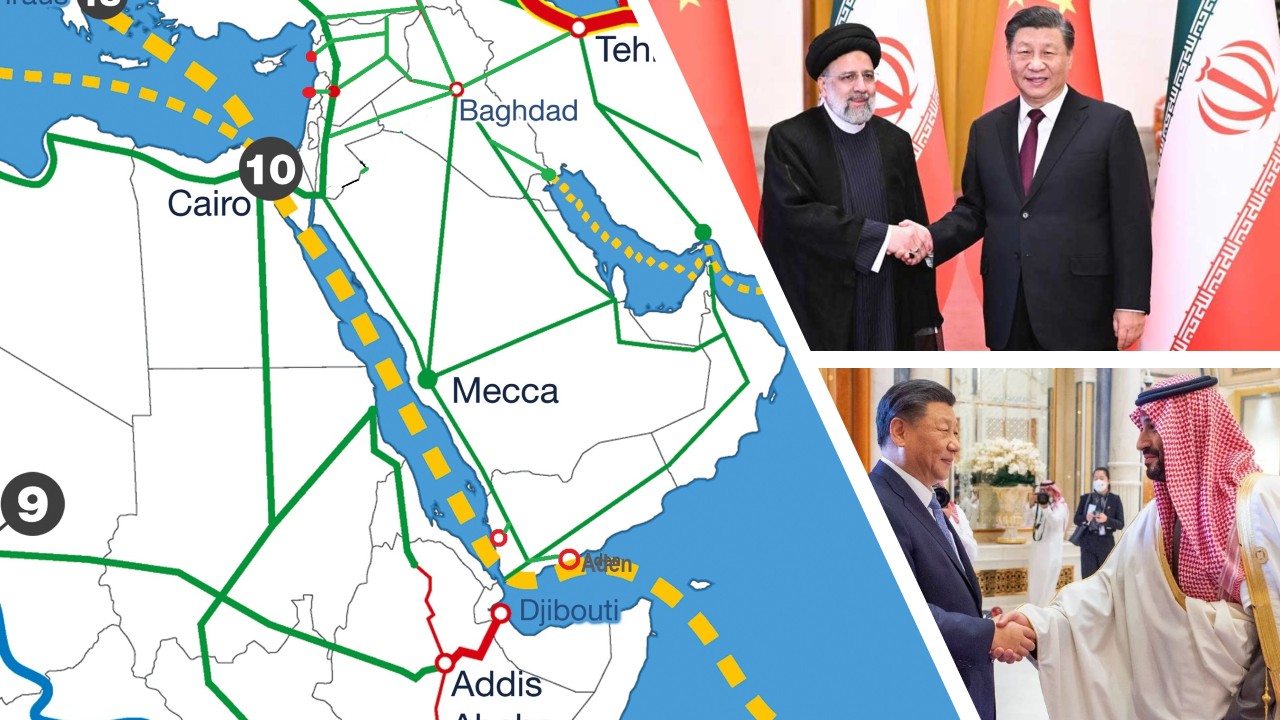
China’s approach to this region is based on, bedsides the above, on the principle of common prosperity as a prerequisite for security. This area has slowly but certainly become a focus of China’s economic and foreign policy since President Xi presented his “1+2+3” policy in the China-Arab Summit of 2014, and his visit to the region in 2016 which took him to Egypt, Saudi Arabia, and Iran. The December 2022 summit between President Xi and the leaders of the Arab World in Riyadh, Saudi Arabia, highlighted the enormous potential that exists for cooperation, industrialization, and trade. “China is now the largest trading partner of the Arab states, with last year’s trade volume almost doubling from the 2012 level to 431.4 billion U.S. dollars,” said President Xi Jinping in his speech to the Arab leaders.
In his speech to the GCC leaders in Riyadh on December 10, 2022, President Xi outlined the concrete economic and financial measures China was offering to work with the GCC immediately. The “five points” Xi presented should be of interest to study for any serious analyst. They include long-term trade in oil and gas in local currencies, infrastructure projects extending to nuclear power, space exploration and space technology, telecommunications and AI, industrial projects, and transport infrastructure projects. One day before the China-GCC Summit President Xi and Saudi King Salman ben Abdul-Aziz reached a Comprehensive Strategic Partnership agreement. This partnership is symbiotic with Saudi Vision 2030. Immediately, 30 memoranda of understanding (MoUs) were signed between Chinese and Saudi entities. These were concretized as contracts worth US$ 10 billion during the China-Arab Business Forum in Saudi Arabia in June 2023.
In February 2023. Iran (a non-Arab country) finalised a 25-year comprehensive strategic cooperation agreement with China, during the state visit by President Ibrahim Raisi to Beijing. Surprisingly, a month later, in March 2023, China brokered the Iran-Saudi Arabia restoration of diplomatic relations, ending several years of proxy wars between forces allied with the two. By the end of the year 2023, Iran, Saudi Arabian, the United Arab Emirates, Egypt, and Ethiopia were all invited into the BRICS (Brazil, India, Russia, China, and South Africa) creating the BRICS Plus. These nations are also either full members or observers in the Shanghai Cooperation Organisation (SCO) which is increasingly moving from being a mere security cooperation organisation into an economic cooperation mechanism. The Belt and Road Initiative plays a key role on this dynamic.
It is through this type of dynamic, peace and security being anchored in economic and cultural cooperation, that trust can be built among nations and fears and suspicions fanned out. It is imperative that the United States, Nato, and the European Union nations learn the lessons of this type of diplomacy as their ways of forced regime-change, sanctions, and use of violence has only led to more suffering and more endangerment of world peace and stability.
1 Comment
Mike Kaya
Çok faydalı bilgiler, paylaşım için sağolun. Özellikle ilginç analiz hoşuma gitti.
Comments are closed.